
Wenglor Photoelectric Sensor: Through Beam Photo Sensors
Wenglor photoelectric sensors are defined as optical detection devices designed for object presence, position, and distance measurement in automation. The Wenglor Photoelectric Sensor, manufactured by Wenglor, uses through-beam, retro-reflective, and diffuse principles with solid-state emitters, photodiodes, optical filtering, integrated amplification, compact housings, standard mounting formats, and discrete or analog output types suitable for PLC systems across Indian industrial environments.
A Wenglor sensor in this category incorporates optical alignment, suppression options, and structure types that align with recognized classifications for photoelectric sensing used in packaging, material handling, and production machinery. The Wenglor Photoelectric Sensor maintains consistent detection across varied surfaces using defined mechanical housings, electrical interface formats, and recognized sensing modes relevant to industrial automation buyers. This entity is identified as an optical sensing technology type with a solid-state structure, standard photoelectric classification attributes, and discrete or analog interface types supporting machine control integration.
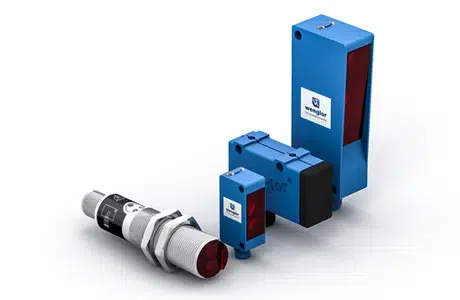
Wenglor Reflex Sensor
- Reflex sensors use light to detect objects.
- They have both a light sender and receiver in one unit.
- Light bounces off objects and returns to the sensor.
- Can detect objects regardless of color or shape.
- Work with various light types: red, infrared, laser.
- Ideal for locating objects, counting, and measuring stack heights.
- Effective even when the background is not specific.
- Primarily use red or infrared light.
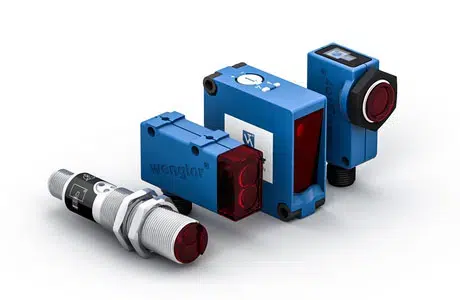
Wenglor Retro-Reflex Sensor
- Reflex light barriers and retro-reflex sensors detect objects using light.
- Both have a light source and receiver in the same unit.
- They send a signal when an object blocks the light beam.
- Retro-reflex sensors with filters identify shiny or reflective surfaces.
- These sensors use red or laser light.
- Interruption of light to a reflector triggers them.
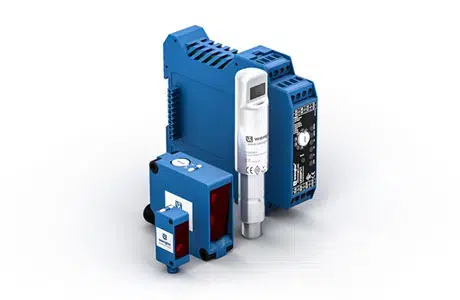
Wenglor Through-Beam Sensors
- Through-beam sensors locate and count small items, identify object edges, and monitor passageways.
- They consist of a light source and a receiver in separate units.
- Utilize laser, red, or infrared light.
- Activation occurs when something interrupts the light beam.
- Capable of detecting objects passing through or present in a specific area.
- Ideal for tracking moving items in a system or identifying object presence.
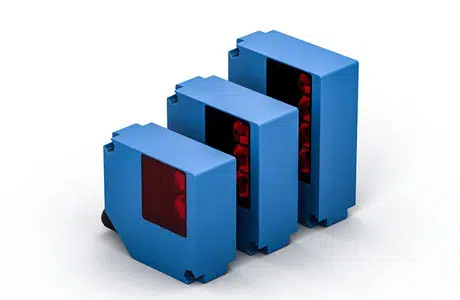
Wenglor Retro-Reflex Sensors with Light Band
- Retro-reflex sensors with a light band detect objects of various edges, shapes, and sizes.
- Use a continuous, even laser light band.
- The light band covers a larger area compared to standard dot-shaped light barriers.
- Effective in detecting small or transparent objects.
- Acts like a wide net, capturing a broader range of object types.
- It is useful for identifying a diverse array of items, regardless of their shape or transparency.
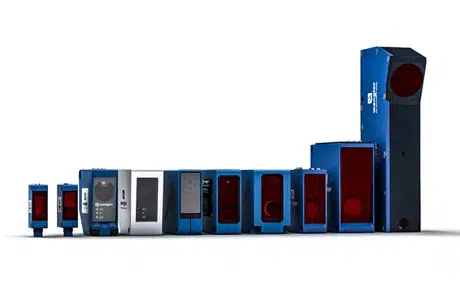
Wenglor Reflex Light Barriers
- Reflex light barriers detect and manage objects by assessing light signal strength and angle.
- They automatically adjust to dirt or temperature changes.
- Remain effective even in imperfect conditions.
- Can be programmed to recognize clear objects against a specific background.
- No need for additional reflectors.
- Ideal for varying environments, such as factories or outdoor settings.
Product List:
Model No |
Image |
Range |
Light Source |
Response Time |
Connection |
Degree of Protection |
|---|---|---|---|---|---|---|
| P1KH002 | 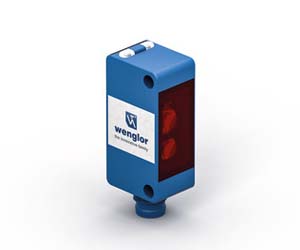
|
150mm | Red Light | 0.5ms | M8 × 1; 4-pin | IP67/IP68 |
| P1EL101 | 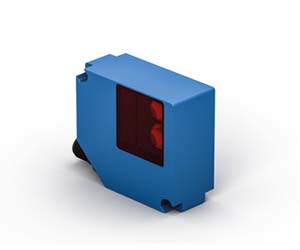
|
2,500 mm | Laser (red) | 1.8 ms | M12 × 1; 4-pin | IP67/IP68 |
| P1KH004 | 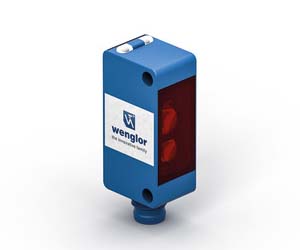
|
150mm | Red Light | 0.5ms | M8 × 1; 3-pin | IP67/IP68 |
| TC66PA3 | 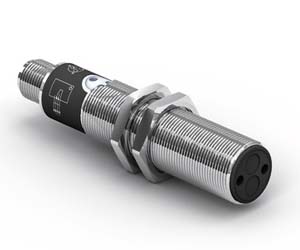
|
1000mm | Infrared Light | 500µs | M12 × 1; 4-pin | IP67 |
| HB03PBT7 | 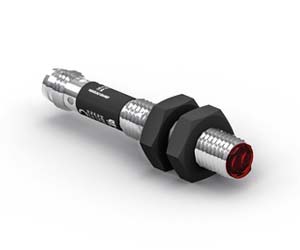
|
30mm | Red Light | 833µs | M8 × 1; 4-pin | IP65 |
| P1PM102 | 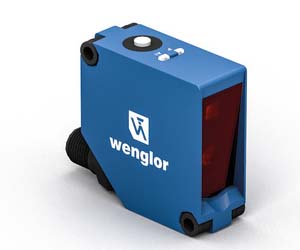
|
1,000 mm | Red Light | 0.6 ms | M12 × 1; 4-pin | IP67/IP68 |
| L1FL66VD | 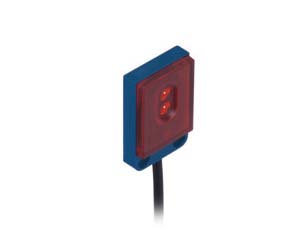
|
1,400 mm | Red Light | 250 µs | Cable, 3-wire, 2 m | IP67 |
| P1KS002 | 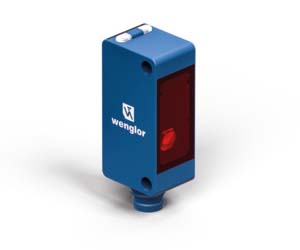
|
6,000 mm | Red Light | – | M8 × 1; 3-pin | IP67/IP68 |
| SO983 | 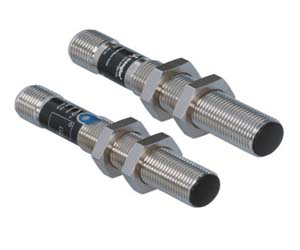
|
10,000 mm | Infrared Light | – | M12 × 1; 4-pin | IP67 |
| P1EL200 | 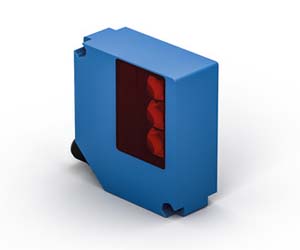
|
2500mm | Laser(red) | 2.9ms | M12 × 1; 4-pin | IP67/IP68 |
Frequently Asked Questions
What is the frequency of a photoelectric sensor?
A photoelectric sensor is a tool that uses light to tell if something is there, how far away it is, or if it’s missing. It works really fast, checking things thousands of times in a second. This speed is measured in kilohertz (kHz). For example, a 40 kHz sensor can check 40,000 times every second. These sensors are really important in factories where things move quickly. They help in making sure everything is in the right place and working correctly. Photoelectric sensors are great for jobs where you need to spot things fast and accurately
Are photoelectric sensors analog or digital?
Photoelectric sensors can have either analog or digital outputs. A sensor with a digital output gives a simple on/off signal. This is like saying “yes” or “no” to whether it sees something. These are good for checking if an object is there or not. Examples of digital outputs are PNP/NPN, relay, and solid state relay.
Analog outputs from a sensor change with what they measure. They give a continuous signal that can show different levels, not just on or off. This is good for measuring things that change smoothly, like temperature or distance. Examples of analog outputs are 0-10 Vdc and 4-20 mA.
Some sensors might even have both types of outputs or use special outputs for network communication. So, photoelectric sensors can be flexible in how they send information
What is the wavelength of a photo sensor?
Photo sensors, like photodiodes and phototransistors, can sense light in different wavelength ranges. They can detect from ultraviolet light to far infrared light. Most of these sensors are best at seeing longer wavelengths, like red and infrared light.
The human eye sees light wavelengths from 400 nm to 750 nm. Red LEDs in sensors are around 660 nm, and green ones are about 550 nm. Infrared sensors work just outside what we can see and are good in dusty places. Each type of photo sensor is made to be best at detecting certain light wavelengths
If you need more details about our Wenglor Photoelectric Sensor We’re here to help – IndMALL Automation