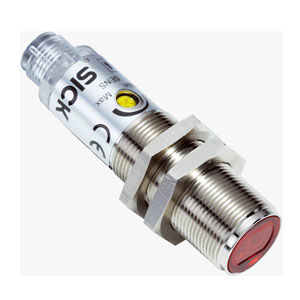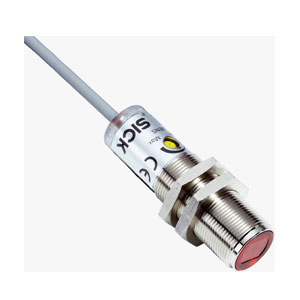
Sick VTF180-2P41112 Photoelectric Sensor
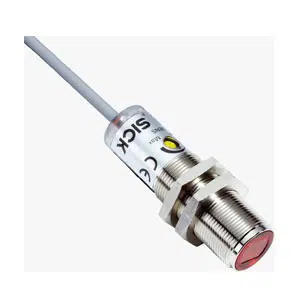
The Sick VTF180-2P41112 Photoelectric Sensor offers a Cylindrical design, 1 mm ... 140 mm sensing range, LED light source, PNP output, and Cable, 4-wire, 2 m 7) connection. Manufactured by Sick under the Sick Photoelectric Sensor category, this model belongs to the V12 Series.
| Brand | Sick |
| Product Type | Photoelectic Sensor |
| Model Number | VTF180-2P41112 |
Sick VTF180-2P41112 Photoelectric Sensor – Technical Specifications
| Specification | Value |
|---|---|
| Functional principle | Photoelectric proximity sensor |
| Functional principle detail | Background blanking |
| Dimensions (W x H x D) | 18 mm x 18 mm x 62.5 mm |
| Housing design (light emission) | Cylindrical |
| Housing length | 62.5 mm |
| Thread diameter (housing) | M18 x 1 |
| Optical axis | Axial |
| Sensing range max. | 1 mm ... 140 mm |
| Sensing range | 1 mm ... 100 mm |
| Focus | - |
| Type of Light | Visible red light |
| Light source | LED |
| Light spot size (distance) | Ø 8 mm (100 mm) |
| Angle of dispersion | - |
| Wave length | 645 nm |
| Adjustment | Potentiometer, 270° (Sensing range) |
| Supply voltage UB | 10 V DC ... 30 V DC |
| Ripple | ± 10 % |
| Current consumption | 30 mA 3) |
| Switching output | PNP |
| Switching mode | Light/dark switching |
| Switching mode selector | Selectable via L/D control cable |
| Output current Imax. | ≤ 100 mA |
| Response time | ≤ 0.5 ms 5) |
| Switching frequency | 1,000 Hz 6) |
| Connection type | Cable, 4-wire, 2 m 7) |
| Protection class | III |
| Housing material | Metal, Nickel-plated brass and PC |
| Optics material | Plastic, PMMA |
| Enclosure rating | IP67 |
| Ambient operating temperature | –25 °C ... +55 °C |
| Ambient temperature, storage | –40 °C ... +70 °C |
| Weight | 95 g |
The Sick VTF180-2P41112 Photoelectric Sensor is a highly advanced proximity sensor designed for challenging detection tasks requiring background suppression. It uses background blanking technology to detect targets between 1 mm and 100 mm with exceptional accuracy while ignoring objects or surfaces beyond its set range—ideal for applications involving shiny or variable backgrounds. The sensor emits a visible red LED light at 645 nm wavelength, forming an 8 mm light spot at 100 mm distance for focused detection in tight industrial environments.
Engineered in a cylindrical M18 housing with a length of 62.5 mm, it features an axial optical axis and is built from a robust combination of nickel-plated brass and PC. The front lens is crafted from high-durability PMMA plastic, offering optical clarity and environmental resistance. This sensor supports light/dark switching logic via a selectable L/D control cable and delivers a PNP switching output capable of handling up to 100 mA. With a fast response time of ≤ 0.5 ms and a high switching frequency of 1,000 Hz, it can keep up with fast production lines and moving parts with ease.
The VTF180-2P41112 operates on a supply voltage of 10 V DC to 30 V DC, with a maximum current consumption of 30 mA and ±10% ripple tolerance, making it power-efficient and stable under voltage fluctuations. The integrated 270° potentiometer allows fine adjustment of the sensing range, while the prewired 4-wire, 2-meter cable ensures quick integration into existing systems. Rated with an IP67 protection class and designed for operating temperatures from –25°C to +55°C, this sensor is ideal for rugged use in dusty, humid, or fluctuating environments. Visit the official Sick product page for more details.
The Sick WL4S-3F2130 Photoelectric Sensor is frequently used in automation systems to detect parts moving on a conveyor or approaching a stop point. It helps prevent errors by ensuring that only the right object triggers an action like sorting, stopping, or signaling.
For junior maintenance engineers, this sensor is straightforward to install using the visible red beam, which makes alignment easier during setup. Its fast 0.5 ms response time is critical in avoiding missed detections when objects move quickly. Additionally, its ability to block out the background helps reduce false readings caused by reflective surfaces or conveyor edges, making it reliable in dynamic environments.
Senior engineers rely on this model when precision and consistency are important for process flow, especially in packaging, assembly, or inspection tasks. For engineering students, it serves as a great learning tool to understand how background blanking works and how sensors integrate with PLCs and control systems. Overall, the WL4S-3F2130 showcases Sick’s commitment to building intelligent sensors that make automation smarter, safer, and more efficient.
Related Products