Sick Photoelectric Sensors
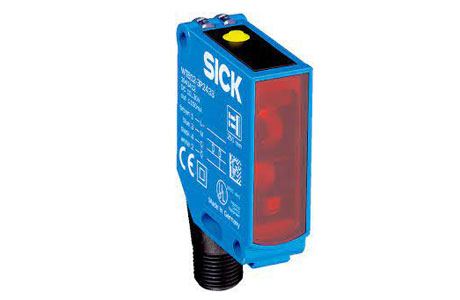
Sick Photoelectric Sensors – W12 Series
- Sensing Range: 0 to 7 meters max.
- Light Source: LED, visible red light (640 nm wavelength).
- Output: PNP digital, light/dark switching, max output current ≤ 100 mA.
- Housing: Rectangular metal, dimensions 15.6 mm x 48.5 mm x 42 mm.
- Connection: M12, 4-pin connector.
- Enclosure Rating: IP66, IP67, IP69K.
- Operating Temperature: –40 °C to +60 °C.
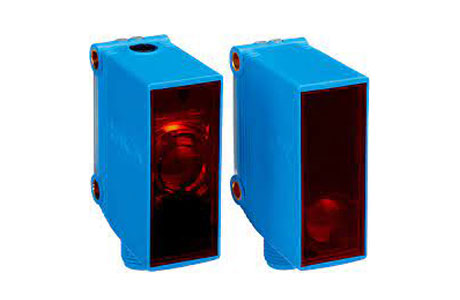
Sick Retro Reflective sensor – G10 Series
- Dimensions: 20 mm x 50 mm x 39 mm.
- Sensing Range: 40 mm to 950 mm.
- Light Source: PinPoint LED, 625 nm wavelength.
- Output: PNP, light/dark switching, max output current ≤ 100 mA.
- Response Time: ≤ 500 µs; Switching Frequency: 1,000 Hz.
- Connection: M12, 4-pin connector; Enclosure Rating: IP67.
- Operating Temperature: –30 °C to +60 °C.
- Supply Voltage: 10 V DC to 30 V DC.
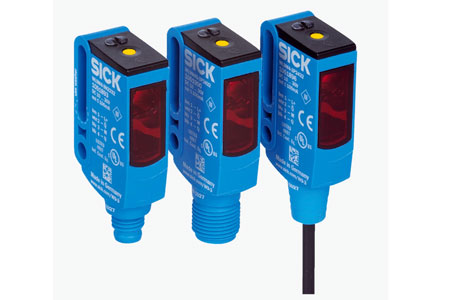
Sick Background Suppression Sensor – W9 Series
- Dimensions: 12.2 mm x 50 mm x 23.6 mm.
- Sensing Range: Max 20 mm to 350 mm; typical 20 mm to 200 mm.
- Light Source: PinPoint LED, visible red light (650 nm wavelength).
- Output: NPN, light/dark switching, max output current ≤ 100 mA.
- Response Time: < 0.333 ms; Switching Frequency: 1,500 Hz.
- Connection: Cable, 4-wire, 2 m; Enclosure Rating: IP66, IP67, IP69K.
- Operating Temperature: –40 °C to +60 °C.
- Supply Voltage: 10 V DC to 30 V DC.
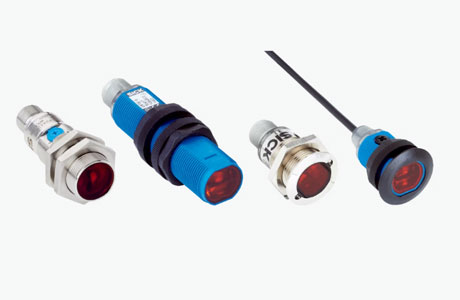
Sick Cylindrical Photoelectric Sensor – GR18 Series
- Dimensions: 18 mm x 18 mm x 73.5 mm.
- Sensing Range: Max 3 mm to 350 mm; typical 3 mm to 250 mm.
- Light Source: LED, infrared light (850 nm wavelength).
- Output: NPN, light/dark switching, max output current ≤ 100 mA.
- Response Time: < 1,000 µs; Switching Frequency: 500 Hz.
- Connection: Male connector M12, 4-pin; Enclosure Rating: IP67.
- Operating Temperature: –25 °C to +55 °C; Supply Voltage: 10 V DC to 30 V DC.
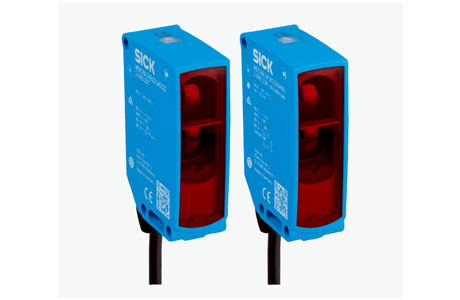
Sick Reflective Sensor – W26 Series
- Sensing Range: 0 m to 18 m (max), recommended 0 m to 12 m.
- Output: Push-pull (PNP/NPN), max output current ≤ 100 mA.
- Response Time: ≤ 500 µs; Switching Frequency: 1,000 Hz.
- Connection: Male connector M12, 4-pin.
- Housing: Rectangular, plastic, dimensions 24.6 mm x 82.5 mm x 53.3 mm.
- Enclosure Rating: IP66, IP67, IP69.
- Operating Temperature: –40 °C to +60 °C; Supply Voltage: 10 V DC to 30 V DC.
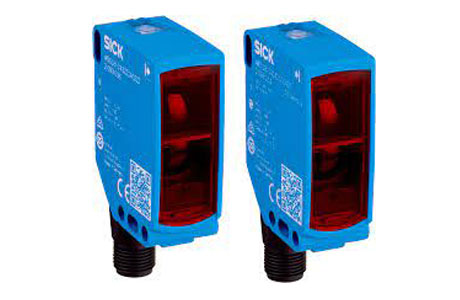
Sick Through Beam Sensors – W16 Series
- Sensing Range: 0 m to 45 m (max), recommended 0 m to 30 m.
- Output: Push-pull (PNP/NPN), max output current ≤ 100 mA.
- Response Time: ≤ 500 µs; Switching Frequency: 1,000 Hz.
- Connection: Cable with M12 male connector, 4-pin.
- Housing: Rectangular, dimensions 20 mm x 55.7 mm x 42 mm.
- Enclosure Rating: IP66, IP67, IP69.
- Operating Temperature: –40 °C to +60 °C; Supply Voltage: 10 V DC to 30 V DC.
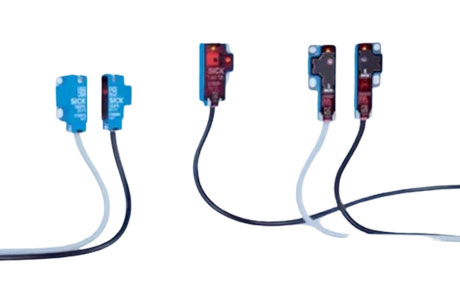
Sick Beam Sensor – G2F Series
- Detection: Background suppression.
- Size: As small as 14 mm x 24 mm x 3.5 mm.
- Sensing Range: Up to 700 mm, depending on the model.
- Power: 10 V DC to 30 V DC, 20 mA consumption.
- Output: NPN/PNP, < 50 mA max; Response Time: < 0.625 ms; Frequency: 800 Hz.
- Connection: Cable or M8 connector.
- Temperature Range: –20 °C to +50 °C (operating).
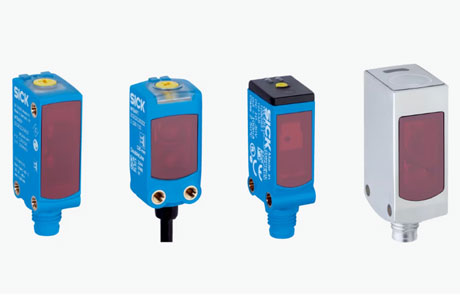
Sick Miniature Photoelectric Sensors – W4 Series
- Sensing Range: 4 mm to 150 mm.
- Light Source: PinPoint LED, 650 nm.
- Voltage: 10 V DC to 30 V DC; Output: NPN, ≤ 100 mA.
- Response Time: < 0.5 ms; Frequency: 1,000 Hz.
- Size: 16 mm x 39.5 mm x 12 mm.
- Material: Plastic, ABS/PMMA; Protection: IP67, IP66.
- Temperature Range: –40 °C to +60 °C.

Sick Sensor Photoelectric – W2 Series
- Size: 7.7 x 21.8 x 13.5 mm.
- Range: Max 1.2 m, typical 0.55 m.
- Light: PinPoint LED, 640 nm; Voltage: 10 V DC to 30 V DC.
- Output: PNP, ≤ 50 mA.
- Response Time: < 0.5 ms; Frequency: 1,000 Hz.
- Connection: M8 connector, 3-pin.
- Material: ABS/PC plastic; Protection: IP67.
- Temperature Range: –25 °C to +50 °C.
Sick Photoelectric Sensors Suppliers
🛠️ Get Quotes Instantly from Sick Vendors

✔ Verified🌟 Trusted Vendor
Deals in PAN India
Dealing Photoelectric Sensor Brands: Omron, Autonics, Pepperl Fuchs, Leuze, Sick, Banner

✔ Verified🌟 Trusted Vendor
Deals in PAN India
Dealing Photoelectric Sensor Brands: Sick, Baumer, Banner

✔ Verified🌟 Trusted Vendor
Deals in South India
Dealing Photoelectric Sensor Brands: Omron, Autonics, Sick, Telemecanique

✔ Verified
Deals in PAN India
Dealing Photoelectric Sensor Brands: IFM, Sick, Pepperl Fuchs, Wenglor
Sick Photoelectric Sensors Models

WL12-3P2431
Range: 0 m ... 7 m
Output: PNP
IP: IP66 / IP67 / IP69K

WTF12-3P2431
Range: 30 mm ... 175 mm
Output: PNP
IP: IP66 / IP67 / IP69K

WTB12-3P2461S02
Range: 50 mm ... 700 mm
Output: PNP
IP: IP66 / IP67 / IP69K

GTB6-P4211
Output: PNP
Application: General Detection
IP: IP67

GL6-F7511
Output: Light/Dark Switching
Application: Industrial Use
IP: IP67

GTB6-N1241
Output: NPN
Application: Object Detection
IP: IP67
Frequently Asked Questions
How does a SICK photoelectric sensor work?
A SICK photoelectric sensor emits a beam of light and detects the reflection from a target object. The sensor’s receiver measures the intensity of the reflected light, which is influenced by factors like object color and distance. The sensor then processes the light signal and generates an output, indicating the presence or absence of an object.
SICK offers various types of photoelectric sensors, each designed for specific applications. These sensors are widely used in industrial settings for reliable and accurate detection tasks.
Which photoelectric sensor has longest range of detection?
The SICK W16-2 Long Range Photoelectric Sensor is known for its extended range of several meters, making it suitable for distance measurement and object detection in warehouse automation, material handling, and outdoor monitoring applications.
Can photoelectric sensor measure distance?
Yes, certain photoelectric sensors, specifically those based on time-of-flight (ToF) technology, can measure distance. These sensors emit a light signal and calculate the time it takes for the light to travel to the target object and return. By analyzing the time of flight, the sensor can determine the distance.
These sensors are commonly used for distance measurement in industrial applications such as object positioning, level sensing, and collision avoidance systems. However, not all photoelectric sensors have distance measurement capabilities, so it’s important to choose the appropriate sensor type for your specific needs.
What kind of radiation does a photoelectric sensor use?
Photoelectric sensors commonly use either infrared (IR) or visible red light radiation. Infrared light, beyond the visible spectrum, is often used due to its reliability and resistance to ambient light interference. Visible red light, within the visible spectrum, is sometimes utilized for alignment or visual indication purposes.
The selection between IR and red light depends on the application requirements and the characteristics of the objects being detected.
Please share your Sick Photoelectric Sensors Requirement to sales@indmall.in