
Baumer Photoelectric Sensors – O200, OT300 Photo Sensor
Baumer Photoelectric Sensors are industrial optical devices that detect object presence by emitting and receiving controlled light beam signals. They are used in industrial automation for presence detection, positioning, counting, and material flow monitoring, supporting sensing modes like through-beam, retro-reflective, and diffuse, with standardized housings, response times, supply voltages, outputs, and environmental protection ratings across manufacturing and process environments in India industrial installations.
Selection depends on sensing principle, light source type, sensing distance, target surface properties, mounting arrangement, alignment tolerance, output configuration, wiring method, ambient light immunity, switching frequency, and enclosure rating to ensure stable detection and compatibility with PLC and controller inputs in industrial control systems. This entity defines non-contact photoelectric sensing technology, built in compact rectangular or cylindrical structures, classified by through-beam, retro-reflective, or diffuse optical methods, interfaced via PNP or NPN digital outputs, and organized for series-to-model selection; see Baumer sensors within industrial automation ecosystems in India.

Baumer Photoelectric Sensors: Subminiature
- Size: Ultra-compact designs starting from 4 mm.
- Range: Long sensing ranges up to 10 m.
- Beam Shape: Options for line or point beam.
- Housing: Available in plastic and stainless steel.
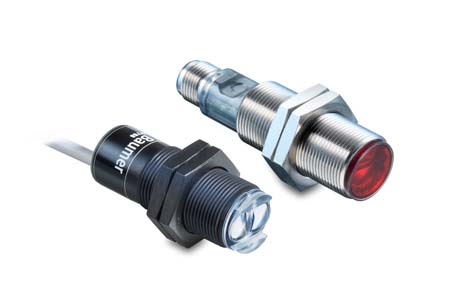
Baumer Photoelectric Sensor: Cylindrical M18
- Housing: M18 standard in plastic, brass, or stainless steel.
- Sensor Options: 6 principles for varied applications.
- Sensing Range: Extensive, up to 55 meters.
- Durability: Stainless steel with IP 69K and chemical-resistant optics.
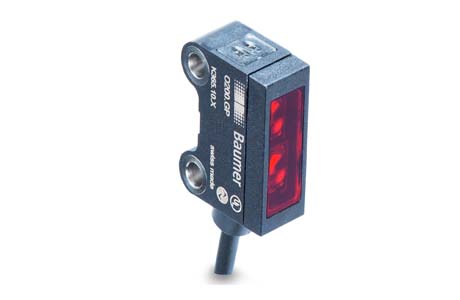
Baumer O200
- Size: Compact, starting from 8 mm.
- Configuration: Adjustable via qTeach or IO-Link.
- Light Source: Features LED and laser with qTarget.
- Beam Shape: Offers point and line beam shapes.
- Sensing Range: Diffuse sensors effective up to 200 mm; through-beam sensors up to 6 m.
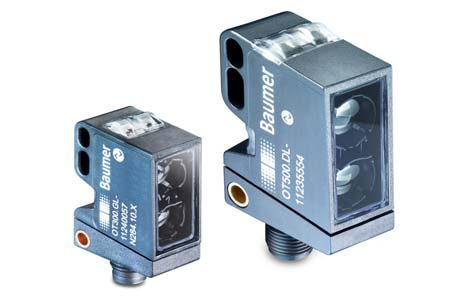
Baumer OT300/OT500
- Range: Up to 2.6 m with time-of-flight technology.
- Design: Miniaturized at 12.9 x 32.3 x 23 mm; standard at 18 x 45 x 32 mm.
- Output Options: 0-10 V DC, 4-20 mA, background suppressor, SmartReflect.
- Connectivity: IO-Link interface, dual channel in standard model.
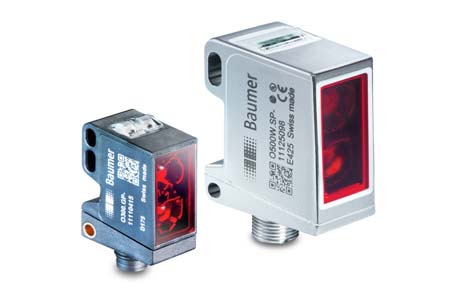
Baumer Photo Sensor: O300 / O500
- Microcontroller: Advanced and powerful.
- Sensor Options: 7 principles, 4 light sources, line/point beams.
- Ease of Use: Simple installation and operation.
- Connectivity: IO-Link, Industry 4.0, and IoT-ready.
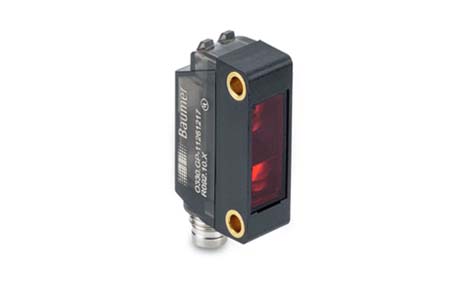
Baumer Photo Sensors: O330
- Quick Setup: Enhanced with qTarget for rapid readiness.
- Configuration: Adjustable through qTeach.
- Light Source: PinPoint LED, offering linear or pointed beams.
- Range: Diffuse sensors up to 385 mm; through-beam up to 12 m.
IndMALL offers an extensive range of Baumer Photoelectric Sensors, including the advanced O200 and OT300 series, which cater to diverse industrial needs. These sensors are designed for easy integration into various systems, ensuring quick and hassle-free setup.
The Baumer O200 series is compact and highly effective in detecting objects in tight spaces, making it ideal for applications with limited space. In contrast, the OT300 series is robust, capable of operating in challenging environments, and offers long-distance detection, making it perfect for demanding industrial conditions. Both series ensure precise and reliable performance, even under harsh environments, and are built for durability to meet a wide range of industrial requirements.
Choose IndMALL for high-quality Baumer Photo Sensors tailored to your specific needs. Our products are built to deliver precision, reliability, and long-lasting performance across India.
Our Dealing Photoelectric Sensor Brands



Frequently Asked Questions
What is the purpose of photoelectric?
Photoelectric sensors are devices used for detecting objects. They use light to sense objects. These sensors are small and work well for various materials. They can detect different object surfaces, like shiny or dark ones.
These sensors are used in many industries. They help in manufacturing and packaging. They can detect objects without touching them. This makes them useful for delicate or moving items.
Photoelectric sensors are easy to use. They can be quickly set up and adjusted. They work well in different environments, even in harsh conditions. This makes them reliable for many tasks.
What are the features of photoelectric?
Photoelectric sensors can work with different types of light, like infrared or laser. These sensors are great because they can sense objects from far away without touching them. This is really helpful for items that are delicate or moving.
They come in different sizes, so some can fit in small spaces while others have a longer range. They’re tough and can work in bright light, and darkness, and even resist water and dust. Plus, they’re easy to set up and use, making them handy for lots of different jobs.
What do photoelectric sensors measure?
Photoelectric sensors measure the presence or absence of objects. They use a light beam to do this. When an object breaks the beam, the sensor detects it. This tells us if something is there or not.
These sensors can also measure how far away an object is. They do this by checking how long it takes for light to bounce back. This is useful for knowing the distance of objects.
Some photoelectric sensors can even tell the difference between colors. They use light to see if an object matches a certain color. This is helpful in sorting things based on color.
What type of light is a photoelectric sensor?
A photoelectric sensor mainly uses three types of light: infrared, visible, and laser.
Infrared light is a type of light that we can’t see. It’s often used in photoelectric sensors because it’s good at detecting objects without being visible.
Visible light sensors use the kind of light we can see. These are used when it’s important to see the light beam, like in some safety applications.
Laser light is very focused and sharp. It’s used in sensors that need to be very precise, like in measuring small distances or detecting tiny objects.
If you want to know more about Baumer Photoelectric Sensors, just get in touch with us.