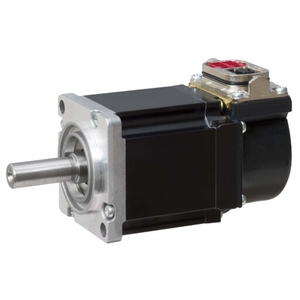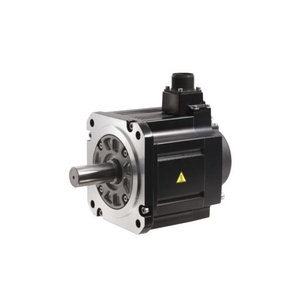
Mitsubishi HG-KR13B - Servo Motors
The Mitsubishi HG-KR13B Servo Motor delivers efficient motion output with its 0.1 kW rating and low inertia configuration for automation. The HG-KR13B provides 0.32 Nm rated torque, 1.1 Nm maximum torque, 3000 rpm speed, a 22-bit encoder, IP65 protection, a straight shaft, and supports 6000 rpm operation. It is positioned under the Mitsubishi servo lineup, integrated within Mitsubishi Servo Motors and aligned with the MELSERVO-J4 Series.

| Brand | Mitsubishi |
| Product Type | Servo Motors |
| Product | HG-KR13B |
Mitsubishi Servo Motors HG-KR13B Technical Specifications:
| Specification | Value |
|---|---|
| Series | MELSERVO-J4 |
| Type | HG-KR |
| Power Supply (V) | 200 |
| Rated Capacity (kW) | 0,1 |
| Inertia | LOW INERTIA |
| Rated Torque (Nm) | 0,32 |
| Maximum Torque (Nm) | 1,1 |
| Rated Speed (rpm) | 3000 |
| Inertia (kg*cm2) | 837 |
| Brake | YES |
| Shaft Type | STRAIGHT SHAFT |
| Current Type | AC |
| Encoder Resolution (p/rev) | 4194304 |
| Maximum Speed (rpm) | 6000 |
| Protection Class | IP65 |
| Encoder Type | 22-BIT |
| Depth (mm) | 123 |
| Weight (kg) | 0,74 |
| Width (mm) | 40 |
| Height (mm) | 41,7 |
The Mitsubishi HG-KR13B Servo Motor is a compact low-inertia unit designed for precise positioning tasks in industrial automation. The model delivers 0.1 kW power, 0.32 Nm torque, 3000 rpm speed, and incorporates a 22-bit encoder for stable feedback control. As part of the MELSERVO-J4 Series, the HG-KR13B supports AC operation, straight-shaft configuration, and maintains IP65 protection for reliable machine integration.
The Mitsubishi HG-KR13B Servo Motor is commonly used in light-duty conveyors, pick-and-place modules, compact packaging machines, and indexing assemblies. Its low-inertia rotor enables fast response during accelerations and decelerations, ensuring accurate movement in cyclical sequences. The encoder resolution supports smooth synchronization, making it suitable for small automation mechanisms requiring stable and predictable positioning.
The Mitsubishi HG-KR13B Servo Motor offers consistent motion control performance with its defined torque capacity, encoder precision, and sealed IP65 construction. With a maximum speed of 6000 rpm and low-inertia dynamics, the HG-KR13B provides reliable operational stability suitable for continuous industrial workloads. Mitsubishi’s servo architecture strengthens performance consistency, making this model dependable for compact and repetitive automation tasks.