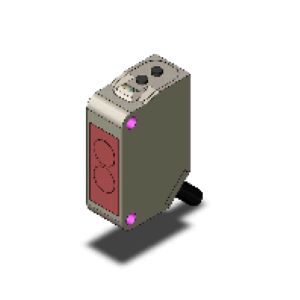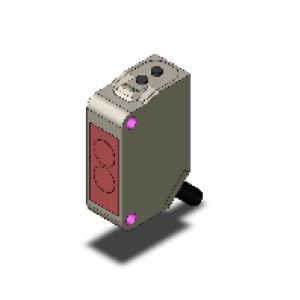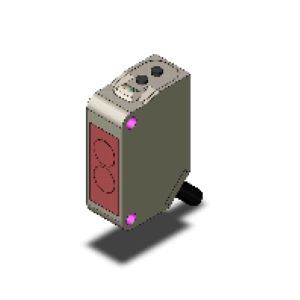
Omron E3ZM-B66 Photoelectric Sensor
Omron E3ZM-B66 is a retro-reflective photoelectric sensor with an M.S.R. function specified for sensing from 100 to 500 mm. Its 650 nm red LED provides the optical source, while the NPN output communicates the switching state to compatible industrial control circuitry. The supplied specification identifies a 500 ml transparent round PET bottle with a 65 mm diameter as the reference target. Light-ON and Dark-ON operation can be selected through the cable switching arrangement. The sensor operates from 10 to 30 VDC and uses an M8 4-pin connector for electrical integration. Current consumption is specified at 15 mA maximum at 30 V. Within the E3ZM Series, the E3ZM-B66 sits within the transparent-object retro-reflective sensor range across Omron Sensing Products.
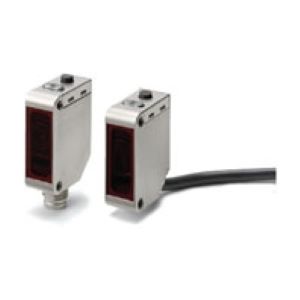
| Brand | Omron |
| Product | Photoelectric Sensors |
| Model Number | E3ZM-B66 |
Omron E3ZM-B66 Photoelectric Sensor – Technical Specifications
| Specification | Value |
|---|---|
| Sensing Method | Retroreflective with MSR function |
| Sensing Distance | 100 to 500 mm |
| Standard Sensing Object | 500-ml, transparent, round PET bottle (65-mm dia.) |
| Light Source | Red LED (650 nm) |
| Power Supply Voltage | 10 to 30 VDC |
| Output Configuration | NPN |
| Connection Method | Connector (M8, 4 pins) |
| Current Consumption | 450 mW max. (current consumption for a 30-V power supply voltage: 15 mA max.) |
| Control Output | Load power supply voltage: 30 VDC max., Load current: 100 mA max. (Residual voltage: 2 V max.) |
| Operation Mode | Light ON/Dark ON cable switch selectable |
| Response Time | Operate or reset: 1 ms max. |
| Sensitivity Adjustment | Teaching method |
| Indicators | Operation indicator (yellow), Stability indicator (green), and Teaching indicator (red) |
| Ambient Illumination | Incandescent lamp: 3,000 lx max., Sunlight: 10,000 lx max. |
| Ambient Temperature Range | Operating: −40 to 60°C, Storage: −40 to 70°C (with no icing or condensation) |
| Ambient Humidity Range | Operating: 35% to 85%, Storage: 35% to 95% (with no condensation) |
| Insulation Resistance | 20 MΩ min. at 500 VDC |
| Dielectric Strength | 1,000 VAC, 50/60 Hz for 1 min |
| Vibration Resistance | Destruction: 10 to 55 Hz, 1.5-mm double amplitude for 2 hours each in X, Y, and Z directions |
| Shock Resistance | Destruction: 500 m/s2 3 times each in X, Y, and Z directions |
| Protection Circuits | Reversed power supply polarity, Load short-circuit protection, Mutual interference prevention, and Reversed output polarity protection |
| Degree Of Protection | IEC IP67, DIN 40050-9: IP69K |
| Material | SUS316L, PMMA (polymethylmethacrylate), PES (polyethersulfone), Fluoro rubber, PVC (polyvinyl chloride) |
| Weight | Approx. 35 g |
The Omron E3ZM-B66 Photoelectric Sensor uses retro-reflective sensing with an M.S.R. function across a specified range from 100 to 500 mm. A 650 nm red LED establishes the optical path, while the NPN output communicates the switching state to compatible industrial control circuitry. The supplied specification identifies a 500 ml transparent round PET bottle with a 65 mm diameter as the reference target. The sensor operates from 10 to 30 VDC and consumes 15 mA maximum at a 30 V supply. Load supply voltage is specified up to 30 VDC, with load current up to 100 mA and residual voltage of 2 V maximum. Light-ON or Dark-ON operation can be selected through the cable arrangement, while operate or reset time is 1 ms maximum. Teaching-based setup is provided, and an M8 4-pin connector supports electrical integration.
For an Omron retro-reflective sensor requiring NPN output and transparent-object sensing within the stated 100 to 500 mm range, the relevant model is the E3ZM-B66. Operation, stability, and teaching indicators provide visual setup information. Operating temperature is specified from -40 to 60°C, with storage from -40 to 70°C. Reversed supply polarity protection, load short-circuit protection, mutual-interference prevention, and reversed output-polarity protection are specified. SUS316L, PMMA, PES, fluoro rubber, and PVC are listed among the materials. The reference PET bottle specification makes the model relevant where transparent containers are part of the sensing requirement. For a related PNP version with the same stated range, see E3ZM-B86.