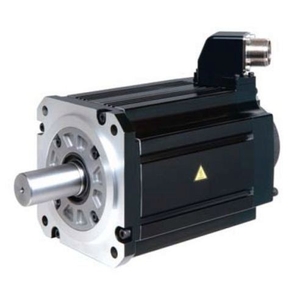
Mitsubishi HK-KT434W - Servo Motors
The Mitsubishi HK-KT434W Servo Motor offers 0.4 kW power, 1.3 Nm torque, and 3000 rpm speed with a low inertia design. It includes a straight shaft, operates on AC supply, and provides a 26-bit encoder delivering 67108864 pulses per revolution for precise feedback. The motor reaches a maximum speed of 6700 rpm and carries an IP67 protection rating for demanding environments. Learn more at mitsubishi electric, explore Mitsubishi servo motors under Mitsubishi Servo Motors, and view its placement within the MELSERVO-J5 series.

| Brand | Mitsubishi |
| Product Type | Servo Motors |
| Product | HK-KT434W |
Mitsubishi Servo Motors HK-KT434W Technical Specifications:
| Specification | Value |
|---|---|
| Series | MELSERVO-J5 |
| Type | HK-KT |
| Power Supply (V) | 400 |
| Rated Capacity (kW) | 0,4 |
| Inertia | LOW INERTIA |
| Rated Torque (Nm) | 1,3 |
| Maximum Torque (Nm) | 4,5 |
| Rated Speed (rpm) | 3000 |
| Inertia (kg*cm2) | 0,41 |
| Brake | NO |
| Shaft Type | STRAIGHT SHAFT |
| Current Type | AC |
| Encoder Resolution (p/rev) | 67108864 |
| Maximum Speed (rpm) | 6700 |
| Protection Class | IP67 |
| Encoder Type | 26-BIT |
| Depth (mm) | 115,5 |
| Weight (kg) | 1,2 |
| Width (mm) | 60 |
| Height (mm) | 76,6 |
The Mitsubishi HK-KT434W Servo Motor is a 0.4 kW low inertia model built for precise industrial automation. It delivers 1.3 Nm rated torque, operates at 3000 rpm, and uses a 26-bit encoder with 67108864 pulses per revolution. As part of the MELSERVO-J5 series, it provides accurate control, fast response, and stable performance in continuous-duty applications.
This motor supports automation systems such as conveyors, compact packaging machines, robotic assemblies, and fast-motion equipment requiring consistent torque and speed. Its low inertia construction enables quick acceleration and smooth stop-start control. With IP67 protection, AC operation, lightweight structure, and efficient feedback resolution, it performs reliably in environments where durability and precision are essential.
The Mitsubishi HK-KT434W Servo Motor offers stable torque output, accurate positioning, and dependable operation for long-term industrial use. Its encoder capability, protective sealing, and MELSERVO-J5 compatibility make it suitable for applications needing predictable motion control. Engineers prefer this model for its integration flexibility, controlled performance, and consistent operation across varied automation tasks.