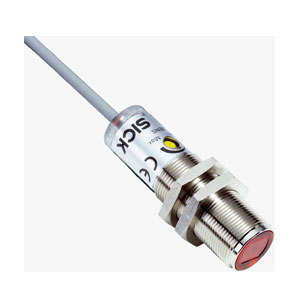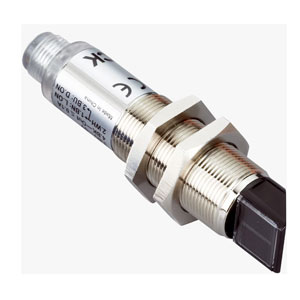
Sick VTB180-2P42412 Photoelectric Sensor
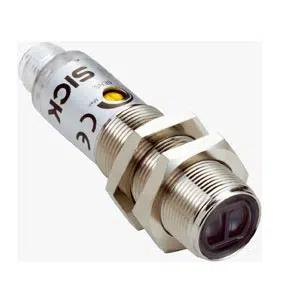
The Sick VTB180-2P42412 photoelectric sensor provides 200 mm sensing range, PNP output, and 632 nm red light for automation. Manufactured by Sick, this photoelectric sensor uses background suppression, operates on 10–30 V DC, offers ≤0.5 ms response time, and features IP67 metal housing with M12 connector, classified under Sick Photoelectric Sensors within the V12 series.
| Brand | Sick |
| Product Type | Photoelectic Sensor |
| Model Number | VTB180-2P42412 |
Sick VTB180-2P42412 Photoelectric Sensor – Technical Specifications
| Specification | Value |
|---|---|
| Functional principle | Photoelectric proximity sensor |
| Functional principle detail | Background suppression |
| Dimensions (W x H x D) | 18 mm x 18 mm |
| Housing design (light emission) | Cylindrical |
| Housing length | - |
| Thread diameter (housing) | M18 x 1 |
| Optical axis | Axial |
| Sensing range max. | 10 mm ... 350 mm |
| Sensing range | 30 mm ... 200 mm |
| Focus | Approx. 2.8° |
| Type of Light | Visible red light |
| Light source | LED |
| Light spot size (distance) | Ø 15 mm (300 mm) |
| Angle of dispersion | Approx. 2.8° |
| Wave length | 632 nm |
| Adjustment | Potentiometer, 4 turns (Sensing range) |
| Supply voltage UB | 10 V DC ... 30 V DC |
| Ripple | ± 10 % |
| Current consumption | 30 mA 3) |
| Switching output | PNP |
| Switching mode | Light/dark switching |
| Switching mode selector | Selectable via L/D control cable |
| Output current Imax. | ≤ 100 mA |
| Response time | ≤ 0.5 ms 5) |
| Switching frequency | 1,000 Hz 6) |
| Connection type | Male connector M12, 4-pin |
| Protection class | III |
| Housing material | Metal, Nickel-plated brass and PC |
| Optics material | Plastic, PMMA |
| Enclosure rating | IP67 |
| Ambient operating temperature | –25 °C ... +55 °C |
| Ambient temperature, storage | –40 °C ... +70 °C |
| Weight | 47 g |
The VTB180-2P42412 Sick 632 nm Photoelectric Sensor is a proximity-type sensing device designed for industrial automation applications. This Sick model operates with a 30–200 mm sensing range, background suppression principle, and a PNP switching output. The VTB180-2P42412 belongs to the V12 series and runs on 10–30 V DC, supporting consistent object detection in compact machine installations.
In automation environments, the VTB180-2P42412 Sick 632 nm Photoelectric Sensor is used in conveyors, packaging equipment, assembly lines, and inspection stations. Its proximity sensing with background suppression enables reliable detection of objects at defined distances. The ≤0.5 ms response time, axial optical alignment, and IP67 enclosure help maintain stable switching performance in dusty, vibration-prone, and continuous-operation industrial settings.
The VTB180-2P42412 from Sick combines defined optical characteristics with durable mechanical construction. With PNP output, IP67 enclosure, and M18 cylindrical housing, this V12 series photoelectric sensor meets standard industrial automation reliability requirements. The Sick VTB180-2P42412 photoelectric sensor is suited for engineers requiring predictable sensing behavior and stable long-term operation in factory automation systems.