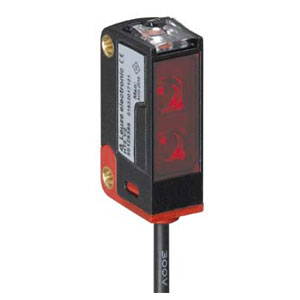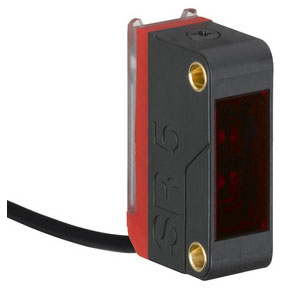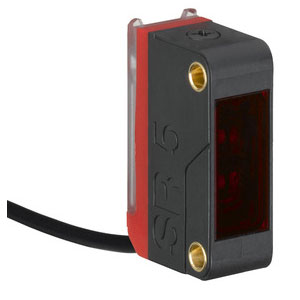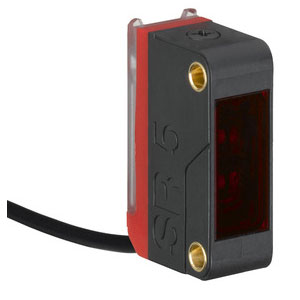
Leuze HT5.1/4 Photoelectric Sensor
Technical Specifications of HT5.1/4 50129400:
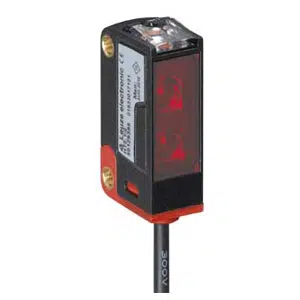
| Brand | Leuze |
| Product Type | Photoelectric Sensor |
| Product | HT5.1/4 |
Leuze HT5.1/4 Photoelectric Sensor – Technical Specifications
| Specification | Value |
|---|---|
| Design | Cubic |
| Operating principle | Diffuse reflection principle with background suppression |
| Sensing Distance | 0.005 ... 0.4 m |
| Beam path | Focused |
| Light source | LED, Red |
| Wavelength | 645 nm |
| Type of light spot geometry | Round |
| Focal distance | 200 mm |
| Supply voltage UB | 10 ... 30 V, DC, Incl. residual ripple |
| Switching Output | Transistor, PNP |
| Switching principle | Light switching |
| Switching frequency | 1,000 Hz |
| Response time | 0.5 ms |
| Function | Signal OUT Voltage supply |
| Type of connection | Cable |
| Cable length | 2,000 mm |
| Sheathing material | PUR |
| Cable color | Black |
| Number of conductors | 3 -wire |
| Wire cross section | 0.2 mm² |
| Dimension (W x H x L) | 11.4 mm x 32.1 mm x 17.8 mm |
| Housing material | Plastic |
| Plastic housing | PC-ABS |
| Lens cover material | Plastic / PMMA |
| Housing color | Black Red |
| Type of display | LED |
| Operational controls | Multiturn potentiometer |
| Ambient temperature, operation | -40 ... 60 °C |
| Ambient temperature, storage | -40 ... 70 °C |
| Degree of protection | IP 67 |
The Leuze HT5.1/4 Photoelectric Sensor features a robust cubic design with a durable PC-ABS plastic housing and compact dimensions of 11.4 mm x 32.1 mm x 17.8 mm, making it suitable for tight installation spaces. Operating on the diffuse reflection principle with background suppression, it uses a red LED light source with a 645 nm wavelength and focused beam geometry to ensure precise detection, even in visually challenging conditions.
With a sensing distance of 5 mm to 400 mm and a focal distance of 200 mm, the sensor offers excellent short-range detection with enhanced object differentiation. It runs on a 10–30 V DC supply and provides a reliable PNP transistor output with light switching functionality. The fast 1,000 Hz switching frequency and 0.5 ms response time make it highly suitable for dynamic production lines. For visibility and ease of use, it includes an LED status indicator and multiturn potentiometer for accurate calibration.
The sensor’s 2-meter PUR-sheathed cable with a 3-wire connection ensures flexible mounting and secure signal transmission, even in high-vibration environments. Rated at IP67, the Leuze HT5.1/4 is well-protected against dust and water, and can operate in extreme temperatures ranging from -40°C to +60°C. Built for reliability, accuracy, and longevity, this sensor meets the demands of modern industrial environments with German-engineered quality. For full specifications, refer to the official Leuze HT5.1/4 product page.
The Leuze HT5.1/4 Photoelectric Sensor is ideal for detecting objects on conveyors, packaging lines, and compact automation machines where space is limited and high precision is needed. Its short sensing range and background suppression make it perfect for differentiating between dark and light parts, especially when glossy or curved surfaces are involved.
For junior and senior maintenance engineers, this sensor eliminates false triggers caused by background reflections or nearby machinery. It’s easy to set up using the multiturn potentiometer, and the LED display provides instant visual feedback. With its 3-wire cable and PNP output, integration into existing PLC systems is straightforward—even for older setups.
Whether used in bottling plants, pharmaceutical lines, small machine tools, or electronics assembly, the Leuze HT5.1/4 Photoelectric Sensor offers a dependable and consistent solution. It helps engineers improve machine uptime, reduce miscounts, and avoid manual intervention—critical in high-speed, repetitive tasks. If you're planning to standardize sensor models across your plant, this model ensures long-term reliability and ease of maintenance, making it a smart choice for any automation upgrade involving a photoelectric sensor.