
Siemens Encoder
Siemens Encoders measure rotational or linear motion by generating digital or analog signals representing position feedback values for automation. These devices use optical or magnetic sensing principles to convert mechanical movement into structured electrical output signals. They provide direction information, pulse generation, and resolution parameters for motion monitoring in industrial environments.
The Siemens Encoder, manufactured by Siemens, uses incremental or absolute signal formats, defined resolution values, and specified mechanical mounting styles to support motion feedback within Siemens automation systems. Key attributes include code disk geometry, sensing modules, shaft or hollow-shaft construction, output drivers, and electrical interfaces such as TTL, HTL, or SSI. These encoders also provide reference marks, count direction channels, permissible speed limits, and noise-tolerant signal transmission for stable position reporting across automation tasks. As an entity, a Siemens Encoder is defined by electromechanical sensing technology, rotary measurement structure, position-feedback classification attributes, and standardized industrial interface types.

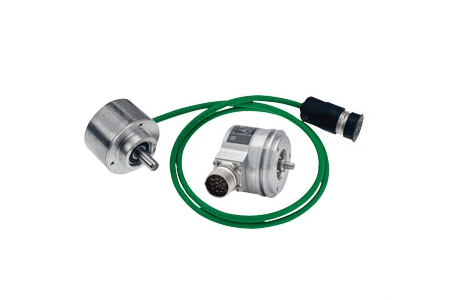
Siemens Incremental Encoder
- Signal Levels: Analog sin/cos 1 Vpp, RS422 (TTL), HTL.
- Resolution: 500 to 5000 signals/revolution.
- Operating Voltage: 5 V DC ±10% or 10 to 30 V DC.
- Frequency: Limit ≥ 180 kHz, Scanning max 300 kHz.
- Current Consumption: Max 150 mA.
- Output Protection: Short-circuit to 0 V.
- Switching Time: ≤ 50 ns or ≤ 200 ns.
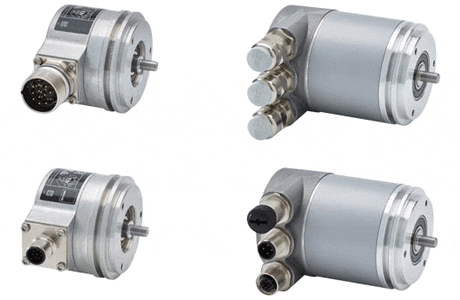
Siemens Absolute Encoder
- Resolution: 24 bit (Single-turn), 36 bit (Multi-turn).
- Voltage: 24 V DC -15% +20%, 4.75-30 V DC, 3.6-14 V DC.
- Current: 37-120 mA (Single-turn), 43-120 mA (Multi-turn).
- Speed: 14,000 rpm (Electrical), 15,000 rpm (Mechanical, Single-turn).
- Shaft Load: Axial 40 N, Radial 60 N at ≤ 6000 rpm.
- Temperature: -40 to +85°C.
- Protection: IP67 (housing), IP64 (shaft input).
Check out our Siemens Encoders with special cables for servo motors. They work great with Siemens motors. We also have a special Siemens rotary encoder module that’s really accurate and reliable for different jobs.
If you’re using Profinet systems, our Siemens Profinet encoders are perfect. They fit right in and work smoothly. Plus, we make it easy to set up with clear instructions for the encoder cables. Count on us at IndMALL for reliable and smart Siemens encoder solutions.
Product List:
Model No |
Image |
Resolution |
Shaft Diameter |
Power Consumption |
Degree of protection |
Cable Length |
|---|---|---|---|---|---|---|
| 6FX2001-2DB02 | 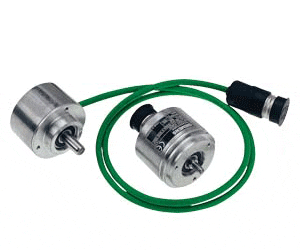
|
1024 S/R | 6 mm | 150 mA | IP67, IP64 | 100 m |
| 6FX2001-5WP24 | 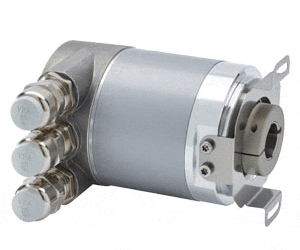
|
27 bit, (8192 increments x 16384) | 15 mm | 100 … 300 mA (2.5 W) | IP67, IP64 | 200.0 m |
| 6FX2001-3CB02 | 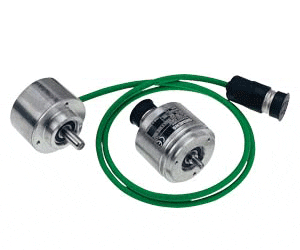
|
1024 S/R | 6 mm | 150 mA | IP67, IP64 | 150 m |
| 6FX2001-5WN13 | 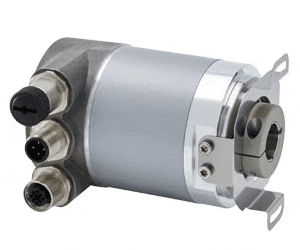
|
13 bit (8192 increments) | 15 mm | 130 … 400 mA (< 4 W) | IP67, IP64 | 100 m |
| 6FX2001-4DA10 | 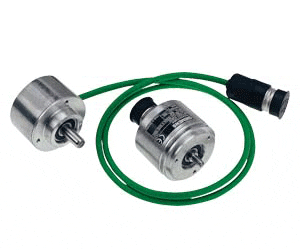
|
100 S/R | 6 mm | 150 mA | IP67, IP64 | 300 m |
| 6FX2001-4DA50 | 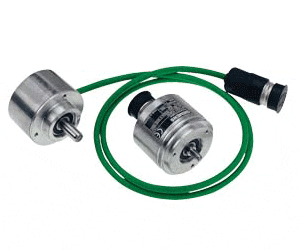
|
500 S/R | 6 mm | 150 mA | IP67, IP64 | 300 m |
| 6FX2001-5QS12 | 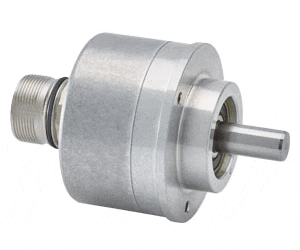
|
13 bit (8192 increments) | 10 mm | 160 mA | IP67, IP64 | 400.0 m |
| 6FX2001-5FN13 | 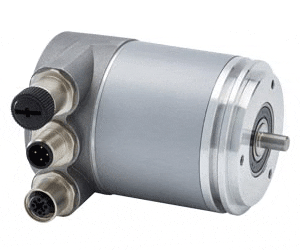
|
13-bit (8192 increments) | 6 mm | 130 … 400 mA (< 4 W) | IP67, IP64 | 100 m |
| 6FX2001-4NA50 | 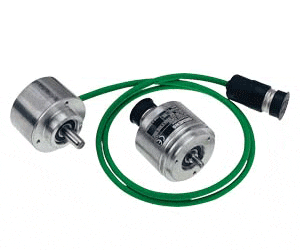
|
500 S/R | 10 mm | 150 mA | IP67, IP64 | 300 m |
| 6FX2001-5QP12 | 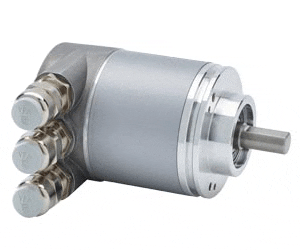
|
13 bit, (8192 increments) | 10 mm | 100 … 300 mA (2.5 W) | IP67, IP64 | 1200 m |




Frequently Asked Questions
What are the advantages of encoders?
Encoders offer precise digital feedback, seamlessly integrating with contemporary control systems. They provide high-quality digital signals, ensuring accurate and reliable data transmission. This digital nature enhances system efficiency and accuracy in various applications.
Why do we use encoder circuits?
Encoder circuits are essential in digital systems for converting parallel inputs into serial outputs. They efficiently compress multiple input signals into fewer output lines. This process simplifies data transmission and processing, enhancing system performance and reliability.
How do you check encoder output?
To check an encoder’s output, first power it up and slowly rotate its shaft. Use a multimeter to monitor the voltage readings. Compare these readings with the encoder’s datasheet specifications. A changing voltage as the shaft turns indicates proper encoder functionality.
Please don’t hesitate to contact us for more details about our Siemens Encoder