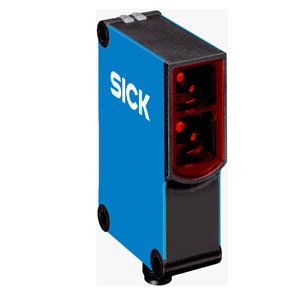
Sick WTB27-3R2611 Photoelectric Sensor
The Sick WTB27-3R2611 Photoelectric Sensor is a high-quality photoelectric sensor from Sick, a global leader in industrial sensing and automation. Known for precision, reliability, and innovation, Sick products are trusted across manufacturing, logistics, and process industries.
| Brand | Sick |
| Product Type | Photoelectric Sensors |
| Product | WTB27-3R2611 |
Sick WTB27-3R2611 Photoelectric Sensor – Technical Specifications
| Specification | Value |
|---|---|
| Functional principle | Photoelectric proximity sensor |
| Functional principle detail | Background suppression |
| Dimensions (W x H x D) | 24.6 mm x 80.6 mm x 54 mm |
| Housing design (light emission) | Rectangular |
| Sensing range max. | 30 mm ... 1,600 mm 1) |
| Sensing range | 100 mm ... 1,600 mm |
| Type of light | Infrared light |
| Light source | LED |
| Light spot size (distance) | Ø 25 mm (800 mm) |
| Wave length | 880 nm |
| Adjustment | Potentiometer |
| Supply voltage UB | 20 V AC/DC ... 250 V AC/DC 1) |
| Power consumption | ≤ 2.5 VA |
| Switching Output | Relay, electrically isolated 2) |
| Output function | Change-over contacts |
| Switching mode | Light/dark switching |
| Switching mode selector | Selectable via time delay selector switch |
| Switching current (switching voltage) | 4 A @ 250 V AC, 4 A @ 24 V DC, 0.125 A @ 250 V DC UL: 4 A @ 250 V AC, general use / 4 A @ 250 V AC, resistive (NO) / 3 A @ 250 V AC, resistive (NC) / 4 A @ 24 V DC, NO, general use / 3 A @ 24 V DC, NC, general use / R300 / B300 (NO contacts only) / 0 °C ... +60 °C |
| Response time | ≤ 10 ms |
| Switching frequency | 10 Hz 3) |
| Connection type | Male connector Q6, 6-pin, AC/UC-coded |
| Protection class | II 6) |
| Housing material | Plastic, ABS |
| Optics material | Plastic, PMMA |
| Enclosure rating | IP65 |
| Ambient operating temperature | –40 °C ... +60 °C 7) |
| Ambient temperature, storage | –40 °C ... +75 °C |
| Weight | 120 g |
The WTB27-3R2611 Sick 880 nm Wavelength Photoelectric Sensor is a rectangular photoelectric proximity sensor designed for background suppression detection. The WTB27-3R2611 Sick 880 nm Wavelength Photoelectric Sensor provides a 100–1600 mm sensing range, uses 880 nm infrared LED, and delivers relay change-over output for AC/DC loads. This model belongs to the WTB series and is applied across industrial automation systems requiring electrically isolated switching.
In industrial automation environments, the WTB27-3R2611 Sick 880 nm Wavelength Photoelectric Sensor is used in conveyors, packaging machines, assembly lines, and automated material handling. Background suppression supports stable object detection despite reflective surfaces. Light and dark switching modes allow flexible control logic, while the relay output enables direct interface with control circuits, timers, and load devices.
The WTB27-3R2611 Sick 880 nm Wavelength Photoelectric Sensor combines IP65 protection, ABS housing, and a wide –40 °C to +60 °C operating range for consistent industrial use. With infrared sensing, selectable switching modes, and relay output capability, this WTB series sensor aligns with Sick reliability standards. The WTB27-3R2611 is suitable for applications requiring dependable detection and electrical isolation.
Related Products