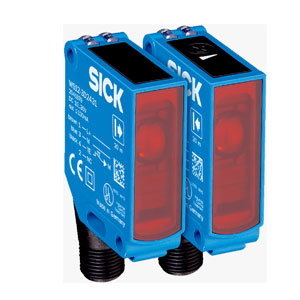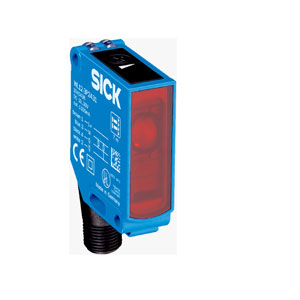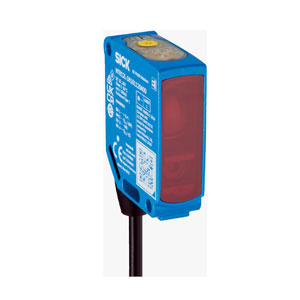
Sick WL12G-3V2572 Photoelectric Sensor
The Sick WL12G-3V2572 is a retro-reflective photoelectric sensor with 4 m sensing range, PNP output, and visible red light LED. This Sick photoelectric sensor operates on 10–30 V DC, uses polarisation filters, supports 1,500 Hz switching frequency, and belongs to the W12 series for industrial automation.
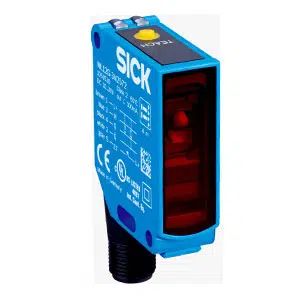
| Brand | Sick |
| Product Type | Photolectric Sensor |
| Model Number | WL12G-3V2572 |
Sick WL12G-3V2572 Photoelectric Sensor – Technical Specifications
| Specification | Value |
|---|---|
| Functional principle | Photoelectric retro-reflective sensor |
| Functional principle detail | Autocollimation |
| Sensing range max. | 0 m ... 4 m |
| Sensing range | - |
| Polarisation filters | Yes |
| Light source | PinPoint LED |
| Type of light | Visible red light |
| Light spot size (distance) | Ø 25 mm (1.5 m) |
| Wave length | 660 nm |
| Adjustment | Single teach-in button |
| Angle of dispersion | - |
| Special applications | Detecting transparent objects |
| Items supplied | - |
| Supply voltage UB | 10 V DC ... 30 V DC |
| Ripple | < 5 Vpp |
| Current consumption | 40 mA |
| Protection class | III |
| Digital Output type | PNP |
| Switching mode | Light/dark switching |
| Signal voltage PNP HIGH/LOW | Approx. VS – 2.5 V / 0 V |
| Output current Imax. | ≤ 100 mA |
| Response time | ≤ 333 µs 4) |
| Switching frequency | 1,500 Hz 5) |
| Output function | - |
| Special feature | Detecting transparent objects |
| Housing | Rectangular |
| Dimensions (W x H x D) | 15.6 mm x 48.5 mm x 42 mm |
| Connection | Male connector M12, 4-pin |
| Housing material | Metal, zinc diecast |
| Front screen material | Plastic, PMMA |
| Enclosure rating | IP66, IP67 |
| Ambient operating temperature | –40 °C ... +60 °C |
| Ambient temperature, storage | –40 °C ... +75 °C |
| Weight | 120 g |
The WL12G-3V2572 Sick 4m PNP Retro-reflective Sensor is a Sick photoelectric sensor designed for reliable object detection in industrial automation systems. This model uses a retro-reflective sensing principle with 4 m maximum sensing range, visible red PinPoint LED at 660 nm, and PNP digital output. Operating on 10–30 V DC, the WL12G-3V2572 is part of the Sick W12 series widely used in automated machinery.
The WL12G-3V2572 Sick 4m PNP Retro-reflective Sensor is applied in conveyors, packaging lines, automated assembly stations, and material handling equipment. Its 333 µs response time and 1,500 Hz switching frequency support stable detection of transparent or reflective objects. Polarisation filters and autocollimation optics help maintain consistent output in challenging industrial environments.
The WL12G-3V2572 from Sick delivers defined optical sensing performance for continuous industrial use. With retro-reflective detection, visible red light emission, and IP-rated enclosure protection, this Sick photoelectric sensor supports dependable operation in automation systems. As a W12 series device, the WL12G-3V2572 is suitable for applications requiring electrical stability, environmental resistance, and repeatable detection across production processes.
Related Products