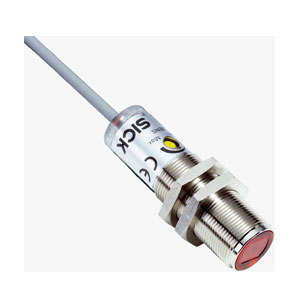
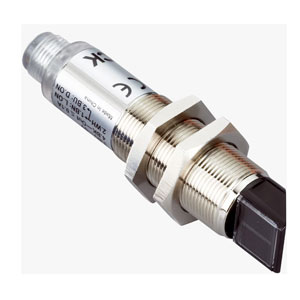
Sick VTF180-2P42417 Photoelectric Sensor
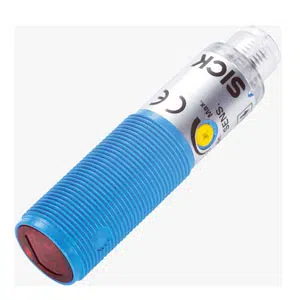
The Sick VTF180-2P42417 Photoelectric Sensor offers a Cylindrical design, 1 mm ... 140 mm sensing range, LED light source, PNP output, and Male connector M12, 4-pin connection. Manufactured by Sick under the Sick Photoelectric Sensor category, this model belongs to the V12 Series.
| Brand | Sick |
| Product Type | Photoelectic Sensor |
| Model Number | VTF180-2P42417 |
Sick VTF180-2P42417 Photoelectric Sensor – Technical Specifications
| Specification | Value |
|---|---|
| Functional principle | Photoelectric proximity sensor |
| Functional principle detail | Background blanking |
| Dimensions (W x H x D) | 18 mm x 18 mm x 69.8 mm |
| Housing design (light emission) | Cylindrical |
| Housing length | 69.8 mm |
| Thread diameter (housing) | M18 x 1 |
| Optical axis | Axial |
| Sensing range max. | 1 mm ... 140 mm |
| Sensing range | 1 mm ... 100 mm |
| Focus | - |
| Type of Light | Visible red light |
| Light source | LED |
| Light spot size (distance) | Ø 8 mm (100 mm) |
| Angle of dispersion | - |
| Wave length | 645 nm |
| Adjustment | Potentiometer, 270° (Sensing range) |
| Supply voltage UB | 10 V DC ... 30 V DC |
| Ripple | ± 10 % |
| Current consumption | 30 mA 3) |
| Switching output | PNP |
| Switching mode | Light/dark switching |
| Switching mode selector | Selectable via L/D control cable |
| Output current Imax. | ≤ 100 mA |
| Response time | ≤ 0.5 ms 5) |
| Switching frequency | 1,000 Hz 6) |
| Connection type | Male connector M12, 4-pin |
| Protection class | III |
| Housing material | Plastic, PBT/PC |
| Optics material | Plastic, PMMA |
| Enclosure rating | IP67 |
| Ambient operating temperature | –25 °C ... +55 °C |
| Ambient temperature, storage | –40 °C ... +70 °C |
| Weight | 18 g |
The Sick VTF180-2P42417 Photoelectric Sensor features background blanking technology to eliminate unwanted signals from shiny or reflective surfaces beyond the target object, making it a reliable choice for constrained environments with unpredictable backgrounds. Built with a cylindrical housing measuring 18 mm x 18 mm x 69.8 mm and a thread diameter of M18 x 1, this sensor easily integrates into standard industrial mounting systems. It emits a sharp visible red LED light at 645 nm wavelength, forming a focused light spot of Ø 8 mm at 100 mm to ensure pinpoint detection across a sensing range of 1 mm to 100 mm, extendable up to 140 mm.
For control and configuration flexibility, the sensor includes a 270° potentiometer that allows engineers to finely adjust the sensing range on-site. It supports both light ON and dark ON switching modes via a PNP output, with selectable logic using the L/D control cable. With a rapid response time of ≤ 0.5 ms and a switching frequency of 1,000 Hz, it is optimized for fast-paced production environments. It operates reliably on a 10 V DC to 30 V DC supply, drawing a current of just 30 mA while delivering a stable output current of ≤ 100 mA. The sensor is housed in durable PBT/PC plastic with PMMA optics and rated to IP67, ensuring protection against dust and moisture for use in harsh industrial conditions, with operating temperatures ranging from –25 °C to +55 °C.
Trusted globally by automation engineers, Sick sensors like the VTF180-2P42417 combine German engineering precision with rugged durability to ensure high-performance detection in packaging, automotive, material handling, and electronics manufacturing. Visit Sick's official site for complete datasheets and certification resources.
The Sick WL4S-3F2130 Photoelectric Sensor is commonly used for real-time presence detection in automated production lines. It helps detect whether a part has arrived at a station, whether a tray is full, or whether a product has moved past a checkpoint — enabling machines to act accordingly, such as triggering sorting arms or activating labelers.
For junior engineers and technicians, this sensor is easy to install and align, thanks to its visible red light and compact size. The sensing distance is easily adjustable using a potentiometer, so even if object sizes or positions vary, detection remains accurate. The IP67 rating ensures long-term reliability, even in dusty or humid conditions.
Senior maintenance engineers value this sensor for its stable operation, fast response time, and the ability to eliminate background noise, reducing false triggers. Its precise detection in close-range scenarios makes it especially useful in robotics and inspection systems. For engineering students, this sensor offers a practical introduction to background blanking technology and how sensors integrate into real-world PLC systems — making it a valuable part of modern smart factory ecosystems.
Related Products