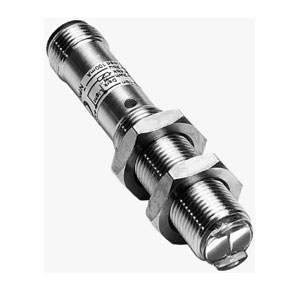
Sick VT12T-2P410 Photoelectric Sensor
The Sick VT12T-2P410 Photoelectric Sensor offers a Cylindrical design, 0 mm ... 115 mm sensing range, LED light source, PNP output, and Male connector M12, 4-pin connection. Manufactured by Sick under the Sick Photoelectric Sensor category, this model belongs to the V12 Series.
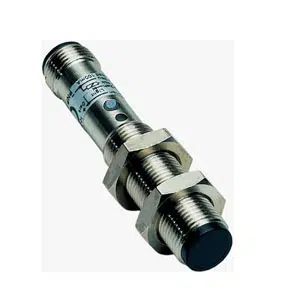
| Brand | Sick |
| Product Type | Photoelectic Sensor |
| Model Number | VT12T-2P410 |
Sick VT12T-2P410 Photoelectric Sensor – Technical Specifications
| Specification | Value |
|---|---|
| Functional principle | Photoelectric proximity sensor |
| Functional principle detail | Energetic |
| Dimensions (W x H x D) | 12 mm x 12 mm x 65.5 mm |
| Housing design (light emission) | Cylindrical |
| Housing length | 65.5 mm |
| Thread diameter (housing) | Round connector M12 x 1 |
| Optical axis | - |
| Sensing range max. | 0 mm ... 115 mm |
| Sensing range | 2 mm ... 100 mm |
| Focus | Approx. 11.4° |
| Type of Light | Infrared light |
| Light source | LED |
| Light spot size (distance) | Ø 20 mm (100 mm) |
| Angle of dispersion | Approx. 11.4° |
| Wave length | 880 nm |
| Adjustment | Single teach-in button (Sensing range) 3), Selectable via control input C (Sensing range) |
| Supply voltage UB | 10 V DC ... 30 V DC |
| Ripple | ± 10 % |
| Current consumption | 20 mA 3) |
| Switching output | PNP |
| Switching mode | Light/dark switching |
| Switching mode selector | Selectable via control input C |
| Output current Imax. | ≤ 100 mA 3) |
| Response time | ≤ 1.25 ms |
| Switching frequency | 400 Hz 5) |
| Connection type | Male connector M12, 4-pin |
| Protection class | III |
| Housing material | Metal, Nickel-plated brass/PA |
| Optics material | Plastic, PMMA |
| Enclosure rating | IP67 |
| Ambient operating temperature | –25 °C ... +70 °C |
| Ambient temperature, storage | –25 °C ... +70 °C |
| Weight | 18 g |
The Sick VT12T-2P410 Photoelectric Sensor is purpose-built for industrial automation environments requiring high-speed and close-range object detection. With its energetic sensing principle and a focused infrared light beam at 880 nm, this sensor detects objects within a range of 2 mm to 100 mm, and can handle up to 115 mm max sensing distance. This short-range precision is enhanced by a light spot size of 20 mm at 100 mm, supported by a focused dispersion angle of 11.4°, ensuring reliable detection even in space-constrained or reflective areas.
The VT12T-2P410 operates with a supply voltage of 10 V to 30 V DC and supports PNP switching output, with selectable Light/Dark mode controlled via input C. A single teach-in button allows easy calibration of sensing range, making this model incredibly user-friendly for field technicians. With a response time of just 1.25 ms and a switching frequency of 400 Hz, the sensor is optimized for fast-moving processes such as pick-and-place systems, compact conveyors, and packaging lines. The low 20 mA current consumption also makes it energy-efficient and PLC-compatible.
Housed in a rugged nickel-plated brass cylindrical body with dimensions of 12 mm x 12 mm x 65.5 mm, the sensor is IP67-rated for protection against dust and water ingress. Its durable PA/PMMA optical elements provide long-term performance in temperatures ranging from –25°C to +70°C. Weighing only 18 grams, the VT12T-2P410 is easy to integrate into robotic end-effectors, compact panels, or mobile equipment. With proven performance and trusted German engineering, this Sick Photoelectric Sensor remains a top choice for automation professionals seeking reliability in high-speed, small-space detection systems. Visit the official Sick website for more technical documentation.
The Sick WL4S-3F2130 Photoelectric Sensor is commonly deployed in smart factories, conveyor systems, and process automation lines where accurate detection of objects is critical before execution of subsequent tasks. It is especially effective in use cases like part positioning, container verification, and presence detection on packaging lines.
What makes this sensor ideal is its ability to suppress background interference. That means even if shiny surfaces, machinery, or changing lighting conditions exist in the background, the sensor still detects only the intended object. For example, if a black component is moving on a metallic tray, the WL4S-3F2130 distinguishes the object without triggering false signals. For Indian maintenance engineers working on fast-moving production lines, this reliability reduces downtime and maintenance load significantly.
From a learning perspective, engineering students studying automation or robotics can gain hands-on understanding of how optical proximity sensing works using the WL4S-3F2130. Concepts like switching logic, sensor alignment, response delay, and object reflectivity become easier to grasp with practical application. This sensor thus supports both industrial reliability and engineering education — making it a smart investment for plants and institutions alike.
Related Products