Sick VT12T-2P112 Photoelectric Sensor
The Sick VT12T-2P112 Photoelectric Sensor offers a Cylindrical design, 0 mm ... 115 mm sensing range, LED light source, PNP output, and Cable, 4-wire, 2 m 6) connection. Manufactured by Sick under the Sick Photoelectric Sensor category, this model belongs to the V12 Series.
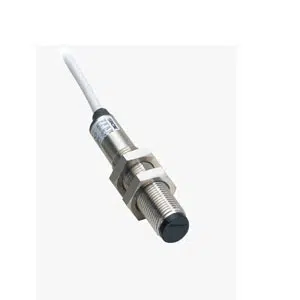
| Brand | Sick |
| Product Type | Photoelectic Sensor |
| Model Number | VT12T-2P112 |
Sick VT12T-2P112 Photoelectric Sensor – Technical Specifications
| Specification | Value |
|---|---|
| Functional principle | Photoelectric proximity sensor |
| Functional principle detail | Energetic |
| Dimensions (W x H x D) | 12 mm x 12 mm x 54.5 mm |
| Housing design (light emission) | Cylindrical |
| Housing length | 54.5 mm |
| Thread diameter (housing) | Round connector M12 x 1 |
| Optical axis | - |
| Sensing range max. | 0 mm ... 115 mm |
| Sensing range | 2 mm ... 100 mm |
| Focus | Approx. 11.4° |
| Type of Light | Infrared light |
| Light source | LED |
| Light spot size (distance) | Ø 20 mm (100 mm) |
| Angle of dispersion | Approx. 11.4° |
| Wave length | 880 nm |
| Adjustment | Single teach-in button (Sensing range) 3), Selectable via control input C (Sensing range) |
| Supply voltage UB | 10 V DC ... 30 V DC |
| Ripple | ± 10 % |
| Current consumption | 20 mA 3) |
| Switching output | PNP |
| Switching mode | Light/dark switching |
| Switching mode selector | Selectable via control input C |
| Output current Imax. | ≤ 100 mA 3) |
| Response time | ≤ 1.25 ms |
| Switching frequency | 400 Hz 5) |
| Connection type | Cable, 4-wire, 2 m 6) |
| Protection class | III |
| Housing material | Metal, Nickel-plated brass/PA |
| Optics material | Plastic, PMMA |
| Enclosure rating | IP67 |
| Ambient operating temperature | –25 °C ... +70 °C |
| Ambient temperature, storage | –25 °C ... +70 °C |
| Weight | 54 g |
The Sick VT12T-2P112 Photoelectric Sensor is a high-performance proximity detection device built with an energetic sensing principle and optimized for reliable object detection within a range of 2 mm to 100 mm, with a maximum sensing distance of 115 mm. This sensor utilizes a precise infrared LED light source with a wavelength of 880 nm, producing a focused beam with a 20 mm spot size at 100 mm and a dispersion angle of 11.4°. These optical characteristics allow it to detect even small, low-contrast objects in challenging environments.
With a compact 54.5 mm cylindrical housing made of nickel-plated brass and PA composite, and an M12 x 1 round connector interface, the sensor is easy to integrate into existing control systems. The cable version comes with a 4-wire, 2-meter prewired output, supporting PNP switching logic and light/dark mode selection via control input C. The integrated teach-in button simplifies configuration for varied sensing ranges, which helps in quick commissioning during plant upgrades or maintenance.
Powering this sensor requires a standard 10 V DC to 30 V DC supply with ripple tolerance of ±10%. The low current consumption of 20 mA and a response time of just 1.25 ms enable rapid object detection in high-speed processes like pick-and-place, bottling, and machine tending. With an IP67 enclosure rating, the VT12T-2P112 is fully protected against dust and water jets, ensuring uninterrupted operation in harsh factory conditions. Maintenance professionals across industries rely on its 400 Hz switching frequency and robust optical build for consistent performance in day-to-day production challenges. Learn more about the VT12T-2P112 from the official Sick website.
The Sick WL4S-3F2130 Photoelectric Sensor is widely used in automated conveyor systems, robotics, and packaging lines where accurate and repeatable object detection is essential. One common use is detecting transparent or reflective items such as PET bottles or metallic components before sealing, sorting, or labeling operations begin.
In real-world Indian factory setups—whether in pharmaceuticals, FMCG, or component assembly—the sensor helps eliminate errors caused by light interference or shiny machinery in the background. Its background suppression capability ensures the sensor only triggers for the intended object, minimizing false readings and reducing downtime. Maintenance engineers often appreciate its ease of alignment and stable sensing distance, which means fewer recalibrations and lower chances of missed parts during fast cycles.
For engineering students and automation trainees, this sensor provides a clear and practical introduction to key automation concepts—like proximity sensing, switching logic, and photoelectric alignment. By observing how these sensors work in live industrial setups, students gain valuable experience in designing and troubleshooting sensor-based systems. That’s why the WL4S-3F2130 is not only a reliable tool for industry, but also a learning asset in technical institutions and training centers.
Related Products