
Sick VL180-2P42436 Photoelectric Sensor
The Sick VL180-2P42436 Photoelectric Sensor offers a Cylindrical design, 0.05 m ... 7 m sensing range, LED light source, PNP output, and Male connector M12, 4-pin connection. Manufactured by Sick under the Sick Photoelectric Sensor category, this model belongs to the V12 Series.
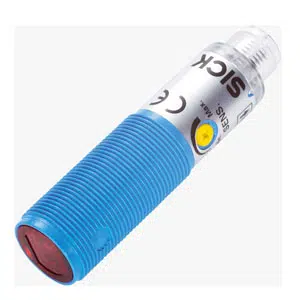
| Brand | Sick |
| Product Type | Photoelectic Sensor |
| Model Number | VL180-2P42436 |
Sick VL180-2P42436 Photoelectric Sensor – Technical Specifications
| Specification | Value |
|---|---|
| Functional principle | Photoelectric retro-reflective sensor |
| Functional principle detail | Dual lens |
| Dimensions (W x H x D) | 18 mm x 18 mm x 70.2 mm |
| Housing design (light emission) | Cylindrical |
| Housing length | 70.2 mm |
| Thread diameter (housing) | M18 x 1 |
| Optical axis | Axial |
| Sensing range max. | 0.05 m ... 7 m |
| Sensing range | 0.05 m ... 6 m |
| Focus | Approx. 4.5° |
| Type of Light | Visible red light |
| Light source | LED |
| Light spot size (distance) | Ø 400 mm (6 m) |
| Angle of dispersion | Approx. 4.5° |
| Wave length | 645 nm |
| Adjustment | Potentiometer, 270° (Sensitivity) |
| Supply voltage UB | 10 V DC ... 30 V DC |
| Ripple | ± 10 % |
| Current consumption | 30 mA 3) |
| Switching output | PNP |
| Switching mode | Light/dark switching |
| Switching mode selector | Selectable via L/D control cable |
| Output current Imax. | ≤ 100 mA |
| Response time | ≤ 0.5 ms 5) |
| Switching frequency | 1,000 Hz 6) |
| Connection type | Male connector M12, 4-pin |
| Protection class | III |
| Housing material | Plastic, PBT/PC |
| Optics material | Plastic, PMMA |
| Enclosure rating | IP67 |
| Ambient operating temperature | –25 °C ... +55 °C |
| Ambient temperature, storage | –40 °C ... +70 °C |
| Weight | 18 g |
The Sick VL180-2P42436 Photoelectric Sensor is built for precise retro-reflective detection with a dual-lens optical system, ensuring accurate sensing over extended distances. Engineered with a compact 70.2 mm cylindrical housing and a standard M18 x 1 thread diameter, it seamlessly integrates into control panels, conveyors, and robotic setups. The sensor emits a visible red LED beam at 645 nm, with a focused light spot of Ø 400 mm at 6 meters and a narrow dispersion angle of 4.5°, making it suitable for detecting small or low-reflectivity targets in high-speed environments.
Its operational range spans from 0.05 m to 6 m, and extends up to 7 m when used with a suitable reflector, providing reliable object detection even in wide automation zones. The PNP switching output is paired with a light/dark mode selector via an external L/D control cable, offering adaptable logic based on object and background conditions. Powered by a 10 V to 30 V DC supply with ±10% ripple tolerance, the sensor consumes only 30 mA while supporting switching currents up to 100 mA.
Industrial engineers value its fast ≤ 0.5 ms response time and 1,000 Hz switching frequency—critical for real-time control systems. The M12 4-pin male connector allows for secure and quick installation, while its PBT/PC housing and IP67 enclosure rating ensure durability against dust, water, and temperature fluctuations (–25°C to +55°C). Weighing only 18 g, this lightweight yet rugged sensor is ideal for applications that demand space efficiency and high reliability. Visit the official Sick website for more details.
The Sick WL4S-3F2130 Photoelectric Sensor plays a critical role in industrial environments where precision and speed are essential. Common use cases include object positioning in conveyor systems, bottle detection in packaging lines, and presence detection in robotic cells. This model is especially effective in applications where background suppression and fast response are vital for system uptime.
For junior maintenance engineers, the sensor offers plug-and-play simplicity with its standard M12 connector and clearly visible red beam for alignment. Even without advanced training, they can install and calibrate the sensor using the intuitive 270° potentiometer to adjust sensitivity. Senior engineers value its rugged IP67 protection and dual-lens system, which ensure minimal false positives even in dusty or reflective conditions.
Engineering students studying automation systems gain real-world insights from the WL4S-3F2130’s performance. Observing how switching frequency, signal strength, and detection angle affect response time gives them hands-on understanding of sensor behavior. This sensor acts as a practical demonstration of how optical detection improves industrial efficiency, safety, and reliability—especially in fast-moving production environments where every millisecond counts.
Related Products