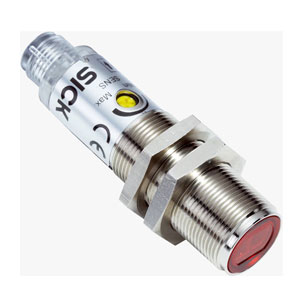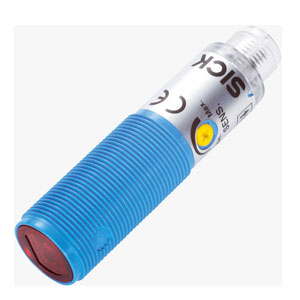
Sick VL180-2P41136 Photoelectric Sensor
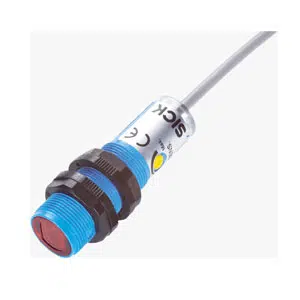
The Sick VL180-2P41136 Photoelectric Sensor offers a Cylindrical design, 0.05 m ... 7 m sensing range, LED light source, NPN output, and Cable, 4-wire, 2 m 7) connection. Manufactured by Sick under the Sick Photoelectric Sensor category, this model belongs to the V12 Series.
| Brand | Sick |
| Product Type | Photoelectic Sensor |
| Model Number | VL180-2P41136 |
Sick VL180-2P41136 Photoelectric Sensor – Technical Specifications
| Specification | Value |
|---|---|
| Functional principle | Photoelectric retro-reflective sensor |
| Functional principle detail | Dual lens |
| Dimensions (W x H x D) | 18 mm x 18 mm x 62.9 mm |
| Housing design (light emission) | Cylindrical |
| Housing length | 62.9 mm |
| Thread diameter (housing) | M18 x 1 |
| Optical axis | Axial |
| Sensing range max. | 0.05 m ... 7 m |
| Sensing range | 0.05 m ... 6 m |
| Focus | Approx. 4.5° |
| Type of Light | Visible red light |
| Light source | LED |
| Light spot size (distance) | Ø 400 mm (6 m) |
| Angle of dispersion | Approx. 4.5° |
| Wave length | 645 nm |
| Adjustment | Potentiometer, 270° (Sensitivity) |
| Supply voltage UB | 10 V DC ... 30 V DC |
| Ripple | ± 10 % |
| Current consumption | 30 mA 3) |
| Switching output | NPN |
| Switching mode | Light/dark switching |
| Switching mode selector | Selectable via L/D control cable |
| Output current Imax. | ≤ 100 mA |
| Response time | ≤ 0.5 ms 5) |
| Switching frequency | 1,000 Hz 6) |
| Connection type | Cable, 4-wire, 2 m 7) |
| Protection class | III |
| Housing material | Plastic, PBT/PC |
| Optics material | Plastic, PMMA |
| Enclosure rating | IP67 |
| Ambient operating temperature | –25 °C ... +55 °C |
| Ambient temperature, storage | –40 °C ... +70 °C |
| Weight | 62 g |
The Sick VL180-2P41136 Photoelectric Sensor is built on a high-accuracy dual-lens optical system that ensures long-range retro-reflective detection across 0.05 m to 6 m, extendable up to 7 m with reflectors. With a visible red LED light at 645 nm and a precisely focused light spot diameter of 400 mm at 6 meters, this sensor provides sharp object recognition, even in complex automation environments. Housed in a compact cylindrical body of 62.9 mm length and M18 x 1 thread, it fits seamlessly into control panels and machinery with limited installation space.
The sensor operates on a stable 10 to 30 V DC power supply with ripple tolerance of ±10%, and consumes only 30 mA, making it energy efficient for 24/7 operations. Its NPN switching output supports light/dark mode selection via a dedicated control cable, providing configuration flexibility to match various detection logics. With a rapid response time of ≤ 0.5 ms and a high switching frequency of 1,000 Hz, the VL180-2P41136 performs exceptionally well in fast-paced processes such as bottling lines, pick-and-place machines, and conveyor applications.
Engineered with industrial-grade PBT/PC housing and PMMA optics, and protected with an IP67 enclosure rating, it is highly resistant to dust, water, and harsh temperatures ranging from –25°C to +55°C. The sensor comes pre-wired with a 4-wire, 2-meter cable for easy integration into PLC or control systems. Maintenance engineers appreciate the built-in 270° sensitivity adjustment potentiometer, which allows fine-tuning without the need for specialized tools. For any application that demands reliability, precision, and ruggedness, Sick VL180-2P41136 remains a top-tier choice. Visit the official Sick product page for more information.
The Sick WL4S-3F2130 Photoelectric Sensor is commonly used in industrial machines to detect the presence or absence of objects, especially on conveyor lines or automated assembly systems. It works well even in situations where lighting varies or where reflective surfaces could otherwise cause sensing errors.
Junior maintenance engineers will find the setup simple. The visible red beam helps with accurate positioning, and the plug-and-play wiring reduces installation mistakes. Its slim build fits well even in tight corners of machinery. Senior engineers value the sensor’s fast 0.5 ms response time and rugged build, which help maintain production line continuity with minimal downtime.
For engineering students, this sensor offers hands-on exposure to essential concepts like response time, sensing range, and logic switching. Observing how it interacts with moving parts teaches them the role of sensor technology in improving safety, efficiency, and machine intelligence. Whether used for training, testing, or live industrial deployment, the WL4S-3F2130 demonstrates the real-world value of precision optical detection in automation.
Related Products