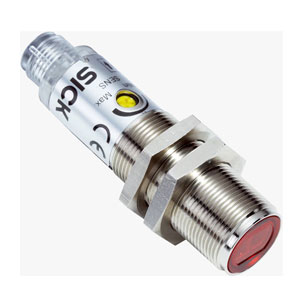
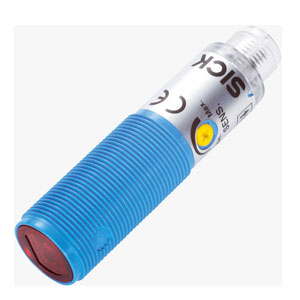
Sick VL180-2N42436 Photoelectric Sensor
The Sick VL180-2N42436 Photoelectric Sensor offers a Cylindrical design, 0.05 m ... 7 m sensing range, LED light source, NPN output, and Male connector M12, 4-pin connection. Manufactured by Sick under the Sick Photoelectric Sensor category, this model belongs to the V12 Series.
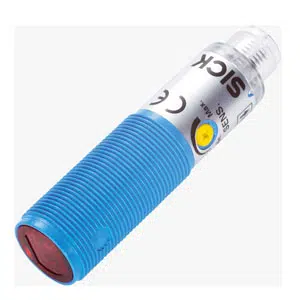
| Brand | Sick |
| Product Type | Photoelectic Sensor |
| Model Number | VL180-2N42436 |
Sick VL180-2N42436 Photoelectric Sensor – Technical Specifications
| Specification | Value |
|---|---|
| Functional principle | Photoelectric retro-reflective sensor |
| Functional principle detail | Dual lens |
| Dimensions (W x H x D) | 18 mm x 18 mm x 70.2 mm |
| Housing design (light emission) | Cylindrical |
| Housing length | 70.2 mm |
| Thread diameter (housing) | M18 x 1 |
| Optical axis | Axial |
| Sensing range max. | 0.05 m ... 7 m |
| Sensing range | 0.05 m ... 6 m |
| Focus | Approx. 4.5° |
| Type of Light | Visible red light |
| Light source | LED |
| Light spot size (distance) | Ø 400 mm (6 m) |
| Angle of dispersion | Approx. 4.5° |
| Wave length | 645 nm |
| Adjustment | Potentiometer, 270° (Sensitivity) |
| Supply voltage UB | 10 V DC ... 30 V DC |
| Ripple | ± 10 % |
| Current consumption | 30 mA 3) |
| Switching output | NPN |
| Switching mode | Light/dark switching |
| Switching mode selector | Selectable via L/D control cable |
| Output current Imax. | ≤ 100 mA |
| Response time | ≤ 0.5 ms 5) |
| Switching frequency | 1,000 Hz 6) |
| Connection type | Male connector M12, 4-pin |
| Protection class | III |
| Housing material | Plastic, PBT/PC |
| Optics material | Plastic, PMMA |
| Enclosure rating | IP67 |
| Ambient operating temperature | –25 °C ... +55 °C |
| Ambient temperature, storage | –40 °C ... +70 °C |
| Weight | 18 g |
The Sick VL180-2N42436 Photoelectric Sensor uses a robust dual-lens optical system to deliver accurate detection at distances of up to 6 meters (extendable to 7 meters with a reflector). The sensor emits visible red LED light at 645 nm, ensuring clear alignment and visual confirmation during installation. It operates on a 10 to 30 V DC supply and consumes only 30 mA, making it energy-efficient even in continuous operation. Designed with a cylindrical M18 x 1 threaded housing measuring 70.2 mm in length, the unit is compact yet rugged, fitting smoothly into tight mounting spaces.
This model supports NPN output with light/dark switching, configurable via the L/D control cable, allowing engineers to adapt detection behavior based on background conditions. The sensor's quick response time of ≤ 0.5 ms and high switching frequency of 1,000 Hz make it ideal for high-speed conveyors, robotic arms, and packaging lines. Its M12 4-pin connector provides secure and rapid wiring in automation panels. The housing, made from PBT/PC with PMMA optics, is IP67-rated—ensuring protection against dust, moisture, and temperature extremes from –25°C to +55°C.
Maintenance engineers appreciate the adjustable 270° potentiometer that enables easy sensitivity tuning, while automation specialists value the consistent performance in demanding environments. Trusted by professionals across industries, the VL180-2N42436 combines Sick’s proven sensor technology with user-friendly features to ensure uptime and precision. Visit the official Sick product page for more information.
The Sick WL4S-3F2130 Photoelectric Sensor is widely used across automation setups for detecting the presence, position, or movement of objects on conveyor belts, assembly lines, and sorting machines. It’s particularly effective in situations where lighting conditions vary or reflective surfaces cause detection errors with ordinary sensors.
For junior maintenance engineers, this sensor simplifies the setup process with its clearly visible red LED beam and standard M12 connector. No complex training is needed—just align, connect, and calibrate. The internal sensitivity adjustment allows for fine-tuning detection without needing extra equipment. For senior engineers, the model offers a fast response time and durable construction that stands up to industrial conditions like dust, water, or vibration—reducing failure rates and service calls.
Engineering students exploring automation systems can learn real-time concepts such as signal conditioning, response lag, and optical detection techniques using this sensor. Observing how switching modes and response times affect system performance builds a strong understanding of how sensors drive reliable automation. The WL4S-3F2130 doesn’t just teach—it performs, consistently and accurately, even under tough operational conditions.
Related Products