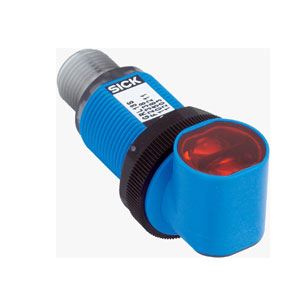
Sick GRL18S-P2431 Photoelectric Sensor
Sick GRL18S-P2431 photoelectric sensor is a dual lens retro-reflective model offering 6 m sensing range with PNP output IP67. This sensor uses visible red PinPoint LED at 650 nm wavelength, provides a Ø 175 mm light spot, operates on 10–30 V DC supply, and switches at 1,000 Hz. It belongs to Sick sensing solutions, listed under Sick Photoelectric Sensors and the GR Series for industrial automation.
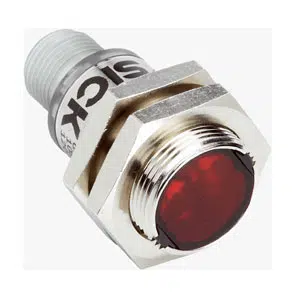
| Brand | Sick |
| Product Type | Photolectric Sensor |
| Product | GRL18S-P2431 |
Sick GRL18S-P2431 Photoelectric Sensor – Technical Specifications
| Specification | Value |
|---|---|
| Functional principle | Photoelectric retro-reflective sensor |
| Functional principle detail | Dual lens |
| Dimensions (W x H x D) | 18 mm x 18 mm x 38.1 mm |
| Housing design (light emission) | Cylindrical |
| Thread diameter (housing) | M18 x 1 |
| Optical axis | Axial |
| Sensing range max. | 0.03 m ... 7.2 m |
| Sensing range | 0.06 m ... 6 m |
| Type of light | Visible red light |
| Light source | PinPoint LED |
| Light spot size (distance) | Ø 175 mm (7 m) |
| Wave length | 650 nm |
| Adjustment | None |
| Indication | LED green, LED yellow |
| Supply voltage UB | 10 V DC ... 30 V DC |
| Ripple | < 5 Vpp |
| Current consumption | 30 mA |
| Switching Output | PNP |
| Switching mode | Light/dark switching |
| Signal voltage PNP HIGH/LOW | - |
| Output current Imax. | ≤ 100 mA 3) |
| Response time | < 500 µs 4) |
| Switching frequency | 1,000 Hz 5) |
| Connection type | Male connector M12, 4-pin |
| Protection class | III |
| Housing material | Metal, Nickel-plated brass and ABS |
| Optics material | Plastic, PMMA |
| Enclosure rating | IP67 |
| Items supplied | Fastening nuts (2 x) |
| Ambient operating temperature | –25 °C ... +55 °C 9) |
| Ambient temperature, storage | –40 °C ... +70 °C |
The GRL18S-P2431 Sick 38.1 mm Retro-reflective Sensor is a photoelectric sensor designed for reliable object detection in industrial automation systems. The GRL18S-P2431 applies a dual-lens retro-reflective optical principle with an axial optical axis, supporting a 0.06–6 m sensing range and a defined Ø 175 mm light spot. It operates with a PNP switching output, requires 10–30 V DC supply, and is enclosed in an IP67-rated M18 metal housing. This sensor belongs to the GR Series used across factory automation environments.
In industrial applications, the GRL18S-P2431 Sick 38.1 mm Retro-reflective Sensor is used on conveyors, packaging equipment, automated assembly stations, and material handling systems. The retro-reflective sensing principle supports consistent detection with reflectors in controlled layouts. Its <500 µs response time and 1,000 Hz switching frequency enable operation in high-speed processes, while the nickel-plated brass and ABS housing ensures durability under standard industrial conditions.
The GRL18S-P2431 from :contentReference[oaicite:0]{index=0} delivers stable sensing behavior through defined optics, controlled electrical performance, and standardized mechanical design. With dual-lens retro-reflective sensing, fixed adjustment design, and IP67 enclosure protection, this photoelectric sensor is suitable for continuous industrial use. Its integration within the GR Series supports compatibility with common automation architectures, making the GRL18S-P2431 appropriate for industrial photoelectric sensing requirements.
Related Products