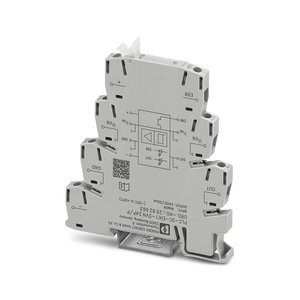
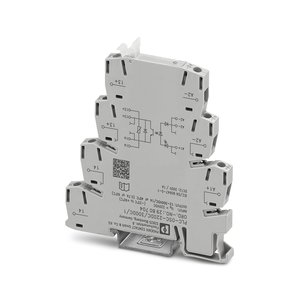
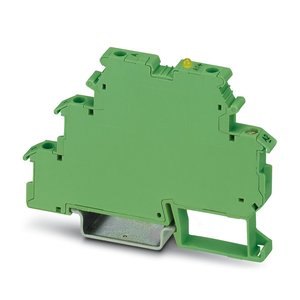
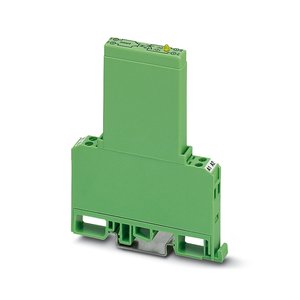
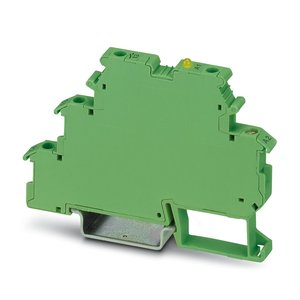
Phoenix EIK1-SVN-24P Solid State Relay Module
The Phoenix EIK1-SVN-24P Solid State Relay Module (Part No: 2940799 ) offers a DEK product, 1 N/O contact contact switching type, electronic design of digital output. Manufactured by Phoenix under the Phoenix Solid State Relay Module category, this model belongs to the Phoenix PLC Series.

| Brand | Phoenix Contact |
| Product Type | Solid state relay Module |
| Model Number | EIK1-SVN-24P |
Phoenix EIK1-SVN-24P Solid State Relay Module – Technical Specifications
| Specification | Value |
|---|---|
| Product type | Solid-state relay module |
| Product family | DEK |
| Application | NAMUR proximity sensors |
| Overvoltage category | III |
| Maximum power dissipation for nominal condition | - |
| Test voltage (Input/output) | - |
| Nominal input voltage UN | 8.2 V DC ±10 % |
| Nominal voltage (plugged-in solid-state relay) | - |
| Input voltage range in reference to UN | - |
| Input voltage range | - |
| Switching threshold "0" signal in reference to UN | - |
| Switching threshold "1" signal in reference to UN | - |
| Typical input current at UN | - |
| Typical response time | - |
| Typical turn-off time | - |
| Operating voltage display | - |
| Protective circuit | 36 V Zener diode as free-wheeling diode; 36 V Zener diode as free-wheeling diode |
| Transmission frequency | 1 kHz |
| Contact switching type | 1 N/O contact |
| Design of digital output | electronic |
| Contact connection type | - |
| Output voltage range | - |
| Limiting continuous current | 50 mA |
| Maximum inrush current | - |
| Voltage drop at max. limiting continuous current | ≤ 1.5 V (UR) |
| Output circuit | - |
| Connection method | Screw connection |
| Stripping length | 8 mm |
| Screw thread | M3 |
| Tightening torque | 0.5 Nm |
| Width | 6.2 mm |
| Height | 80 mm |
| Depth | 56 mm |
| Color | - |
| Ambient temperature (storage/transport) | -25 °C ... 70 °C |
| Temperature | - |
| Humidity | - |
| Vibration | - |
| EMC | - |
| Enclosure | - |
| Mounting Type | DIN rail mounting |
| Mounting Position | any |
| Degree of Protection Relay | - |
| Housing Material | - |
| Output Resistor | - |
The Phoenix Contact EIK1-SVN-24P is purpose-built to support NAMUR proximity sensor interfaces and belongs to the DEK product family—engineered for reliability in harsh industrial environments. Operating at a precise nominal input voltage of 8.2 V DC ±10%, this solid-state relay module offers accurate signal transmission with an electronic 1 N/O contact output. It is designed to handle a limiting continuous current of 50 mA, while maintaining a low voltage drop of ≤ 1.5 V (UR), ensuring energy-efficient and stable operation. With a transmission frequency of 1 kHz, the module supports fast signal response, making it suitable for real-time industrial monitoring systems. Built for space-constrained control panels, this solid-state relay module measures just 6.2 mm in width and mounts easily on standard DIN rails in any orientation. The screw connection terminals with M3 threads and 0.5 Nm tightening torque offer robust electrical connectivity even under vibration. Designed for -25 °C to 70 °C storage and operating conditions, the relay is ideal for both indoor and semi-outdoor panel enclosures. Its built-in 36 V Zener diode protection circuit ensures safe signal transmission while protecting against reverse polarity and voltage spikes—critical in sensitive NAMUR-based systems.
The Phoenix NAMUR SSR Module EIK1-SVN-24P is specifically tailored for applications where precise interfacing with NAMUR proximity sensors is required—commonly found in hazardous areas, PLC input modules, and process control instrumentation. For junior and senior maintenance engineers, this module simplifies sensor integration by converting NAMUR analog signals into reliable digital switching outputs. The clear output behavior and high isolation make it easy to design fault-tolerant systems with minimal troubleshooting.