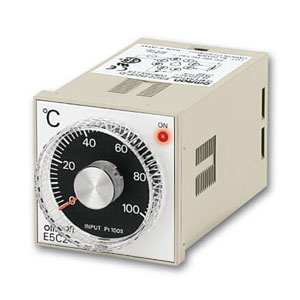
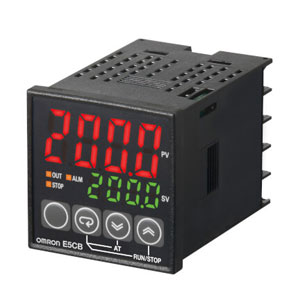
Omron E5AN-HPRR2BM-500 Digital Temperature Controller
The Omron E5AN-HPRR2BM-500 Temperature Controller is a compact and precise Digital Temperature Controller designed for stable, fast-response industrial temperature control. Its 1/4 DIN 96 × 96 × 78 (W × H × D) design supports a versatile 1 point input for accurate sensing across various temperature applications. Operating on 100 to 240 VAC, 50/60 Hz with an allowable range of 85 to 110% of the power supply voltage , it provides ON/OFF or 2-PID control with auto-tuning for consistent temperature stability. The controller features Relay outputs × 2, 2 auxiliary outputs, 11-segment digital display that enhances visibility, its Screw terminal wiring system simplifies installation and reduces panel wiring time. Manufactured by Omron, part of the Omron Temperature Controller range within the Omron E5AN Series.
Omron E5AN-HPRR2BM-500 Temperature Controller - Technical Specifications
Specification
Value
Shape
1/4 DIN 96 × 96 × 78 (W × H × D)
Power supply voltage
100 to 240 VAC, 50/60 Hz
Operating voltage range/ Allowable voltage variable range
85 to 110% of the power supply voltage
Power consumption
100 to 240 VAC: 12 VA
24 VAC/VDC: 8.5 VA (24 VAC)/5.5 W (24 VDC)
Control method
ON/OFF or 2-PID control with auto-tuning
Number of input points
1 point
Input Type/Temperature input
Thermocouple: K, J, T, E, L, U, N, R, S, B, W, or PL II Platinum resistance thermometer: Pt100 or JPt100 Current input: 4 to 20 mA or 0 to 20 mA Voltage input: 1 to 5 V, 0 to 5 V, or 0 to 10 V
Control output 1
Relay outputs × 2
Number of total auxiliary output
2
Setting method
Set digitally using keys on the front panel or by using the RSP input
Indication method
11-segment digital display and individual indicators (7-segments displays also possible); Character height: E5AN-H: PV: 15.8 mm, SV: 9.5 mm, MV: 6.8 mm; E5EN-H: PV: 11.8 mm, SV: 8.1 mm, MV: 5.8 mm; Content of 3-level display: PV/SV/MV, PV/SV/Bank No., or soak time remain; Number of digits: 5 for PV and SV, 4 for MV
Insulation resistance
20 MΩ min. (at 500 VDC)
Dielectric strength
2,300 VAC, 50 or 60 Hz for 1 min (between terminals with different charge)
Vibration resistance
Malfunction: 10 to 55 Hz, 20 m/s2 for 10 min each in X, Y, and Z directions
Destruction: 10 to 55 Hz, 0.75-mm single amplitude for 2 hrs each in X, Y, and Z directions
Shock resistance
Malfunction: 100 m/s2, 3 times each in X, Y, and Z directions
Destruction: 300 m/s2, 3 times each in X, Y, and Z directions
Ambient temperature (Operating)
−10 to 55°C (with no condensation or icing), for 3-year warranty: −10 to 50°C
Ambient temperature (Storage)
−25 to 65°C (with no condensation or icing)
Ambient humidity (Operating)
25% to 85%
Degree of protection
Front panel: IP66, Rear case: IP20, Terminals: IP00
Case color
Black
Terminal type
Screw
Weight
Controller: Approx. 210 g, Adapter: Approx. 4 g × 2
The Omron E5AN-HPRR2BM-500 is frequently assessed alongside other units in the Digital Temperature Controllers group because they share comparable sensor inputs, panel depth behaviour, and loop-control characteristics. Engineers often evaluate Omron E5CC-CX2DSM-005 (DIN48 x 48, ON/OFF or 2-PID control, 24 VAC (50/60 Hz); 24 VDC, Linear current output, 11-segment digital display), Omron E5AC-CX2ASM-000 (DIN 96 x 96, ON/OFF or 2-PID control, 100 to 240 VAC (50/60 Hz), Linear current output, 11-segment digital display), and Omron E5CC-QQ2DSM-006 (DIN48 x 48, ON/OFF or 2-PID control, 24 VAC (50/60 Hz); 24 VDC, Voltage output (for driving SSR), 11-segment digital display) when selecting a controller that fits panel wiring, SSR/relay load stages, and enclosure thermal limits. Reviewing shape, control method, supply voltage class, output structure, and indication style builds a clearer link between field.