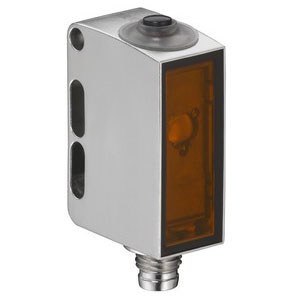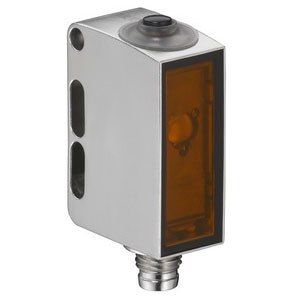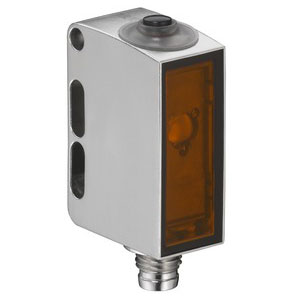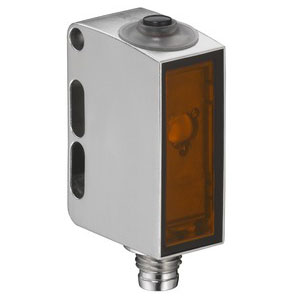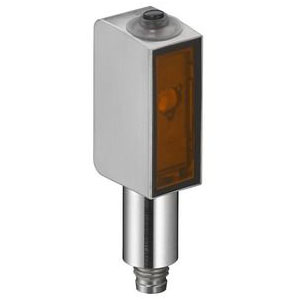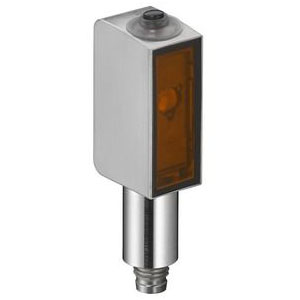
Leuze PRK55C.T3/16-M8 | 50148192
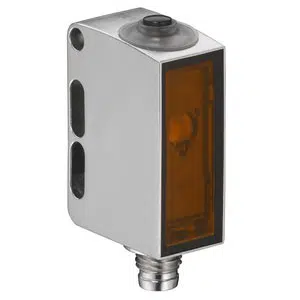
| Brand | Leuze |
| Product Type | Photoelectric Sensor |
| Product | PRK55C.T3/16-M8 |
Leuze COM2 mode retro-reflective photoelectric sensors PRK55C.T3/16-M8 - 50148192 Technical Specifications:
| Specification | Value |
|---|---|
| Design | Cubic |
| Operating principle | Reflection principle |
| Application | Detection of highly transparent bottles Detection of transparent films |
| Special version | Autocollimation Wash-Down design |
| Sensing Distance | 0 ... 3 m, With reflector TK(S) 100x100 |
| Beam path | - |
| Light source | LED, Red |
| Wavelength | 645 nm |
| Type of light spot geometry | - |
| Supply voltage UB | 10 ... 30 V, DC, Incl. residual ripple |
| Switching Output 1 | Transistor, Push-pull |
| Switching principle | IO-Link / light switching (PNP)/dark switching (NPN) |
| Switching Output 2 | Transistor, Push-pull |
| Switching principle | Light switching (PNP)/dark switching (NPN) |
| Switching frequency | 1,500 Hz |
| Response time | 0.33 ms |
| Function | Signal IN Signal OUT Voltage supply |
| Type of connection | Connector |
| Thread size | M8 |
| Type | Male |
| Material | Stainless steel |
| No. of pins | 4 -pin |
| Encoding | - |
| Dimension (W x H x L) | 14 mm x 35.4 mm x 25 mm |
| Housing material | Stainless steel |
| Metal housing | AISI 316L, DIN X2CrNiMo17132, W.No1.4404 |
| Lens cover material | Plastic (PMMA+) with scratch-resistant Indium protective coating |
| Housing color | Silver |
| Type of display | LED |
| Operational controls | Teach button |
| Ambient temperature, operation | -40 ... 70 °C |
| Ambient temperature, storage | -40 ... 70 °C |
| Degree of protection | IP 67/IP 68/IP 69K |
The Leuze PRK55C.T3/16-M8 Photoelectric Sensor features a cubic stainless steel housing crafted from AISI 316L grade metal, ensuring corrosion resistance in washdown applications. It operates on the reflection principle with autocollimation, allowing stable detection of difficult targets such as transparent bottles or glossy films. With a sensing distance of 0 to 3 meters (when used with the TK(S) 100x100 reflector), it guarantees reliable operation in dynamic industrial setups.
At its core, this photoelectric sensor utilizes a 645 nm red LED light source and offers an extremely fast response time of 0.33 ms with a switching frequency of 1,500 Hz, making it suitable for high-speed production lines. Dual push-pull transistor outputs support both PNP and NPN switching modes, and its built-in IO-Link interface simplifies remote configuration and diagnostics. The compact dimensions of 14 mm x 35.4 mm x 25 mm allow it to fit easily into tight machine layouts. The M8 4-pin male connector ensures quick installation, while the PMMA+ lens cover with indium coating offers scratch resistance and optical clarity. With its triple-rated IP67/IP68/IP69K protection and an operating temperature range of -40°C to +70°C, the PRK55C.T3/16-M8 is trusted in sectors where downtime is not an option.
The Leuze PRK55C.T3/16-M8 Photoelectric Sensor is widely used in industrial automation to detect transparent bottles, shrink films, and clear packaging on conveyors, filling lines, and sorting systems. Junior engineers often face difficulties with false detection when using ordinary sensors—this model solves that issue with its advanced autocollimation technology that ensures precise alignment and signal clarity.
Senior maintenance professionals appreciate the IO-Link communication and rugged stainless-steel housing, which allow quick diagnostics and long-term durability, even under wet or dusty conditions. Its fast response time ensures no delay or signal drop in high-speed bottling or labeling lines, reducing line rejections and machine stoppage.
For production units in sectors like pharmaceuticals, beverages, and FMCG, the Leuze PRK55C.T3/16-M8 Photoelectric Sensor is a highly dependable solution. Its ability to handle transparent targets, fast switching capability, and compact form factor make it a top choice for modern automated systems requiring reliability and precision from their photoelectric sensors.