
Kubler Encoder
Kubler encoders are motion-sensing devices used for position, speed, and rotary feedback in industrial automation, covering kubler encoder, kuebler encoder, kubler incremental encoder, and kubler rotary encoder variants. The Kubler Encoder, manufactured by Kubler, operates on optical or magnetic sensing principles and converts mechanical rotation into electrical signals used for control, monitoring, and feedback. Its structure includes optical discs or magnetic tracks, mechanical shaft assemblies, and electrical interfaces arranged in solid-shaft, hollow-shaft, hub-shaft, flange, and Kubler draw wire encoder formats.
Output choices include TTL, HTL, SIN/COS, parallel, and serial communication, allowing engineers to compare kubler encoder price and evaluate compatibility through Kubler. Additional variants such as kuebler incremental encoder and kubler absolute encoder support incremental or absolute classification requirements across motion systems. Kubler encoders are defined as optical or magnetic technology devices with rotary or linear structures, incremental or absolute classifications, and electrical or serial interface formats used in automation applications.
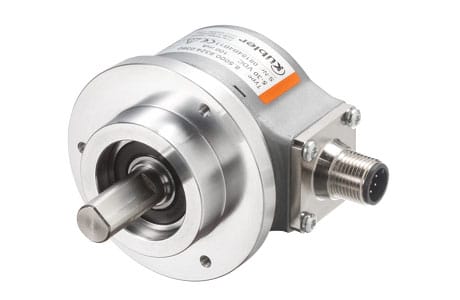
Kubler Rotary Encoder: Ø 50 mm to Ø 70 mm Standard Encoder
- Dimension: Ø 58 mm for most models; Ø 36 mm for certain models.
- Resolution: Ranges from 19 bits singleturn to 24 bits singleturn and 12 bits multiturn.
- Shaft Type: Options include max 12 mm shaft, max 3/8″ shaft, max 1/2″ hollow shaft, max 15 mm hollow shaft, with variations in flat surface or blind hole.
- Special Features: High precision, redundant sensors, Industry 4.0 / IIoT readiness, magnetic insensitivity, resistant, and wear-free.
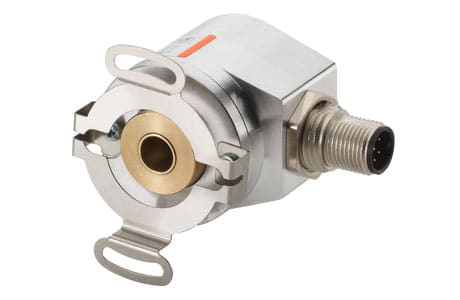
Kübler Incremental Encoders: Ø 36 mm to Ø 40 mm Compact
- Dimension: Ø 58 mm for most models; Ø 36 mm for certain models.
- Resolution: Ranges from 19 bits singleturn to 24 bits singleturn and 12 bits multiturn.
- Shaft Type: Options include max 12 mm shaft, max 3/8″ shaft, max 1/2″ hollow shaft, max 15 mm hollow shaft, with variations in flat surface or blind hole.
- Features: High precision, redundant sensors, Industry 4.0 / IIoT readiness, magnetic insensitivity, resistant, and wear-free.
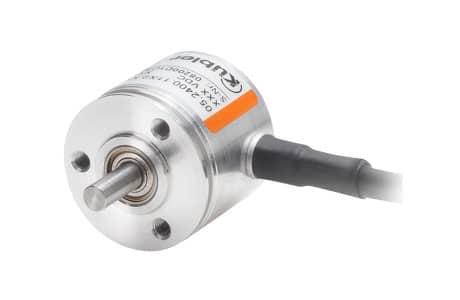
Kubler Encoder 1024 PPR: Ø 24 mm Miniature
- Dimensions: Ø 58 mm (Sendix S58 and F58 Series); Ø 36 mm (Sendix M36 Series).
- Resolution: Up to 24 bits (Sendix S58 and F58 Series); up to 14 bits (Sendix M36 Series).
- Shaft Types: Various options including max 12 mm, max 3/8″, max 1/2″ hollow, and max 15 mm hollow shafts.
- Special Features: High precision, safety application suitability (S58 Series); Industry 4.0/IIoT readiness, magnetic insensitivity (F58 Series); magnetic, wear-free, robust design (M36 Series).

Kübler Hollow Shaft Encoder: Maxi Encoder up to Ø 42 mm
- Dimension: Ø 58 mm for most models; Ø 36 mm for certain models.
- Resolution: Ranges from 19 bits singleturn to 24 bits singleturn and 12 bits multiturn.
- Shaft Type: Options include max 12 mm shaft, max 3/8″ shaft, max 1/2″ hollow shaft, max 15 mm hollow shaft, with variations in flat surface or blind hole.
- Special Features: High precision, redundant sensors, Industry 4.0 / IIoT readiness, magnetic insensitivity, resistant, and wear-free.
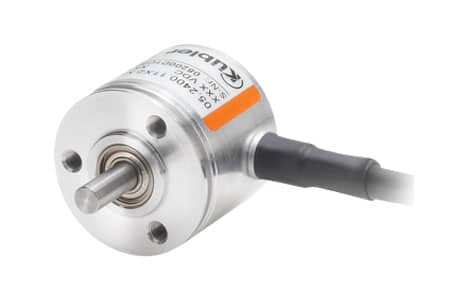
Kübler Rotary Encoders: Ø 24 mm Miniature Encoder
- Dimension: Ø 58 mm for most models; Ø 36 mm for certain models.
- Resolution: Ranges from 19 bits singleturn to 24 bits singleturn and 12 bits multiturn.
- Shaft Type: Options include max 12 mm shaft, max 3/8″ shaft, max 1/2″ hollow shaft, max 15 mm hollow shaft, with variations in flat surface or blind hole.
- Special Features: High precision, redundant sensors, Industry 4.0 / IIoT readiness, magnetic insensitivity, resistant, and wear-free.
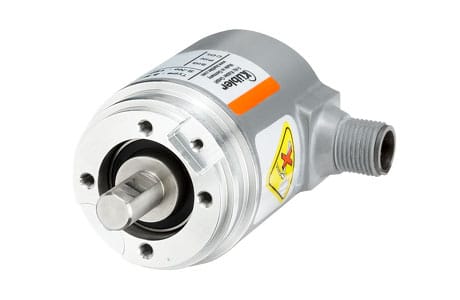
Kübler Absolute Encoders: Ø 36 mm Compact Encoder
- Dimension: Ø 58 mm for most models; Ø 36 mm for specific models.
- Resolution: Ranges from 19 bits singleturn to 24 bits singleturn and 12 bits multiturn.
- Shaft Type: Options include max 12 mm shaft, max 3/8″ shaft, max 1/2″ hollow shaft, and max 15 mm hollow shaft, with flat surface or blind hole variations.
- Key Features: High precision, redundant sensors, Industry 4.0 / IIoT readiness, magnetic insensitivity, resistance, and wear-free design.
Kübler Encoders: Ø 50 mm to Ø 70 mm Absolute Standard
- Dimension: Ø 58 mm (most models), Ø 36 mm (specific models).
- Resolution: 19 to 24 bits, with singleturn and multiturn options.
- Shaft Type: Max 12 mm, max 3/8″, max 1/2″ hollow, max 15 mm hollow.
- Features: High precision, redundant sensors, Industry 4.0 / IIoT compatibility, magnetic insensitivity.
Frequently Asked Questions
What is the use of the Kubler Encoder?
Kubler encoders are used for precise motion control in various applications. They convert mechanical motion into electronic signals, enabling accurate position and speed measurement.
Ideal for industrial automation, they enhance control in machinery, robotics, and conveyor systems, ensuring efficient and reliable operation.
What is a Kubler PROFIsafe Encoder?
A Kubler PROFIsafe encoder is a specialized rotary encoder designed for safety-critical applications. It integrates with the PROFIsafe protocol, ensuring reliable and secure communication in automated systems.
This encoder provides precise position and speed feedback, crucial for safety functions in machinery, enhancing operational safety in industrial environments.
What is the Rotary Encoder Incremental Type?
A rotary encoder of the incremental type is a device that converts rotational motion into digital signals. It generates pulses corresponding to the amount of rotation, allowing precise tracking of angular position and speed.
Unlike absolute encoders, incremental types provide relative position information, requiring a reference point for accurate measurement. They are widely used in automation and control systems.
Which type of Coding is used in Absolute Encoders?
If you require Kubler Encoder, Get a Call: at +91 79955 44066