
GIC Gateways & Converters - Protocol Gateways
IndMALL Automation offers a robust lineup of GIC Gateways and Converters engineered for seamless communication between industrial devices and control systems. Designed to bridge legacy and modern protocols, GIC’s solutions enhance connectivity, ensure data integrity, and support smooth integration across automation networks.
From the versatile RS232 to RS485/RS422 Converters with features like auto-direction control, galvanic isolation (1.5 kV), and ±15 kV ESD protection, to the advanced Lynx+ Protocol Gateways supporting Modbus RTU/ASCII and Modbus TCP, GIC enables reliable serial-to-Ethernet communication with speeds up to 115.2 Kbps. Additionally, GIC’s compact Signal Transducers provide fast and isolated analog signal conversion, making them ideal for space-limited installations.
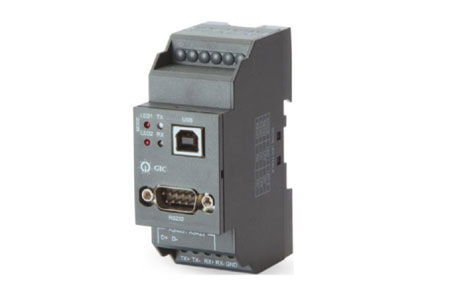
GIC Gateways and Converters - RS232 to RS485 / RS422 Converter
Supports communication speeds from 300 bps to 230 Kbps
Auto-direction control for RS485-2W data transmission
Includes USB 2.0 Type A to Type B cable
Provides 1.5 kV galvanic isolation for enhanced safety
ESD protection of ±15 kV on RS232/RS485 lines
LED indicators for data transmit and receive status
Powered directly via USB port – no external power supply needed
2M DIN rail mountable enclosure for easy installation
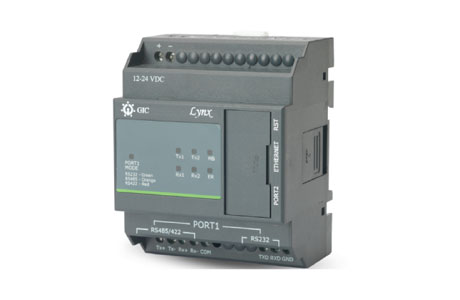
GIC Protocol Converters - Lynx+ Gateway
Supports Modbus RTU and ASCII in both Master and Slave configurations
Enables Modbus TCP (Client/Server) communication over Ethernet networks
Facilitates Raw Serial to Ethernet data conversion using Telnet RFC2217 protocol
Compatible with RS232, RS422, and RS485 serial interfaces
Baud rate support from 300 bps to 115.2 Kbps for serial communication
Ethernet interface with 10/100 Mbps auto-negotiation for seamless connectivity

GIC Signal Transducer
Input and output configurations easily selectable through DIP switch settings
Offers a wide range of analog input-output combinations for versatile applications
Ensures 3-way galvanic isolation up to 3.75 kV for enhanced safety and signal integrity
Delivers a fast response time of less than 100 ms
Slim 22.5 mm profile ideal for space-constrained panel installations
Frequently Asked Questions
What are the three types of gateways?
The three types of gateways are Protocol Gateways, Internet Gateways, and IoT Gateways. Each type serves a different purpose in connecting and managing data between systems.
A Protocol Gateway converts data between different network protocols—for example, from Modbus to BACnet. An Internet Gateway connects a private local network to the public internet. And an IoT Gateway acts as a bridge between IoT devices and cloud platforms, handling data filtering, security, and protocol conversion. These three types of gateways help different systems communicate smoothly and securely.
What is the purpose of a converter?
The purpose of a converter is to change the form of electrical power to match the needs of a device or system. It can convert voltage levels, like stepping up (boosting) or stepping down (reducing) the voltage, depending on the requirement.
Converters are also used to switch between AC and DC power. For example, an AC to DC converter powers electronics from a wall socket. In automation, signal converters or protocol converters help different devices communicate by changing data formats. Simply put, the purpose of a converter is to ensure smooth and safe operation by matching power or signals correctly.
What is the difference between converter and gateway?
The main difference between converter and gateway is in how they handle communication between different systems. A converter changes one protocol or signal type into another—for example, RS232 to RS485. It’s mostly a direct translation without much processing.
A gateway, on the other hand, connects two different networks or systems and can manage more complex tasks. It not only converts protocols but also handles data filtering, formatting, or security. So, while both help devices talk to each other, a gateway is smarter and does more than just convert signals.