

Maintenance teams planning replacements for DSNU-25-400-P-A-35191 frequently review Festo Festo, Festo Dsnu 25 50 P A 19221 and Festo Valves to prevent downtime, checking availability and compatibility with existing systems.
Festo DSNU-25-400-P-A Round Cylinder
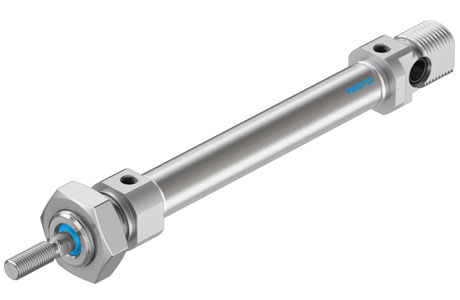
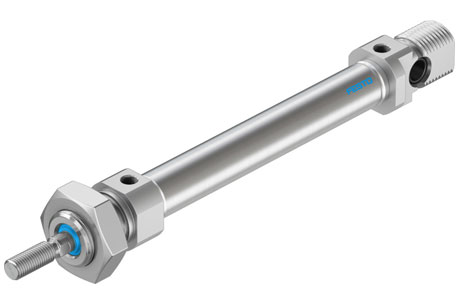
The Festo DSNU-25-400-P-A Round Cylinder offers M10x1.25 rod thread, Male thread piston rod end, 25 mm diameter, andPiston; Piston rod; Cylinder barrel. Manufactured by Festo under the Festo Round Cylinder category, this model belongs to the DSNU Series.

| Brand | Festo |
| Product Type | ISO Cylinder |
| Product | DSNU-25-400-P-A |
Festo DSNU-25-400-P-A Round Cylinder – Technical Specifications
| Specification | Value |
|---|---|
| Stroke | 400 |
| Piston diameter | 25 mm |
| Piston rod thread | M10x1.25 |
| Cushioning | Elastic cushioning rings/plates at both ends |
| Mounting position | optional |
| Conforms to standard | CETOP RP 52 P; ISO 6432 |
| Design | Piston; Piston rod; Cylinder barrel |
| Piston-rod end | Male thread |
| Position detection | Via proximity switch |
| Variants | Piston rod at one end |
| Operating pressure | 1; 10 |
| Mode of operation | Double-acting |
| Operating medium | Compressed air to ISO 8573-1:2010 [7:4:4] |
| Corrosion resistance class CRC | 2 - Moderate corrosion stress |
| LABS (PWIS) conformity | VDMA24364-B1/B2-L |
| Cleanroom class | Class 6 according to ISO 14644-1 |
| Ambient temperature | -20; 80 |
| Impact energy in end positions | 0.3 |
| Theoretical force at 0.6 MPa (6 bar, 87 psi), return stroke | 247.4 |
| Theoretical force at 0.6 MPa (6 bar, 87 psi), advance stroke | 294.5 |
| Moving mass for 0 mm stroke | 71 |
| Additional moving mass per 10 mm stroke | 6 |
| Basic weight for 0 mm stroke | 238 |
| Additional weight per 10 mm stroke | 11 |
| Type of mounting | With accessories |
| Pneumatic connection | G1/8 |
| Note on materials | RoHS-compliant |
| Material cover | Wrought aluminium alloy; Colourless anodised |
| Material seals | NBR; TPE-U(PU) |
| Material piston rod | High-alloy stainless steel |
| Material cylinder barrel | High-alloy stainless steel |
Festo – Global Excellence in Pneumatic Automation
Festo is a world-renowned German brand recognized for its leadership in industrial automation and motion control solutions. Known for its engineering precision, durable product design, and innovation, Festo components are widely used across manufacturing plants in India. From automotive and FMCG to pharma and packaging, Indian engineers trust Festo for reliable pneumatic systems that deliver consistent performance under tough operating conditions.
Model Overview – DSNU-25-400-P-A Cylinder
The DSNU-25-400-P-A is a double-acting pneumatic round cylinder with a 25 mm piston diameter and an extended 400 mm stroke length, ideal for applications requiring long linear movement. It conforms to ISO 6432 standards and includes elastic cushioning rings/plates at both ends, which reduce impact forces and extend component life. The cylinder uses compressed air (ISO 8573-1:2010 [7:4:4]) as its operating medium and supports position detection via proximity sensors, making it compatible with modern automation systems. With a G1/8 pneumatic connection, male-threaded piston rod, and modular mounting options, it’s easy to integrate into existing setups. Built with high-alloy stainless steel and anodised aluminium, this cylinder is RoHS-compliant and corrosion-resistant, suitable for cleanroom use (up to Class 6) and general industrial environments.
Where DSNU-12-70-P-A is Commonly Used
The DSNU-12-70-P-A is a compact round cylinder favored for its light weight and fast response. In Indian industries, it is commonly found in pick-and-place units, assembly automation lines, and test stations. For maintenance teams, it provides a reliable choice for precise, short-stroke actuation in tight spaces where larger cylinders won't fit. It is especially useful in electronics, plastic molding, and small packaging machines. Engineering students working with pneumatics in college labs can easily understand the basics of motion control using this model, from cylinder cushioning and stroke adjustment to pneumatic circuit design. By studying how this smaller cylinder is applied, learners gain hands-on knowledge that directly translates to real-world industrial setups.
Related Products