
During technical comparisons, DSNU-25-30-PPV-A appears alongside Festo Festo, Festo Dsnu 25 50 P A 19221 and Festo Valves so engineers assess signal types, ingress protection, and ambient tolerances accurately.
Festo DSNU-25-30-PPV-A Round Cylinder
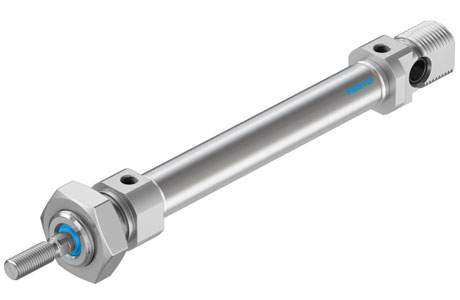
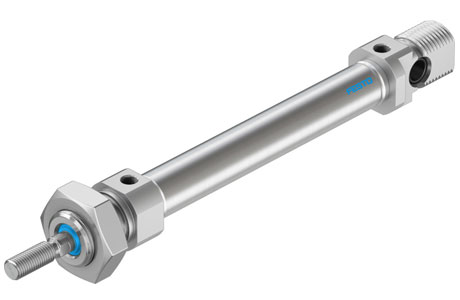
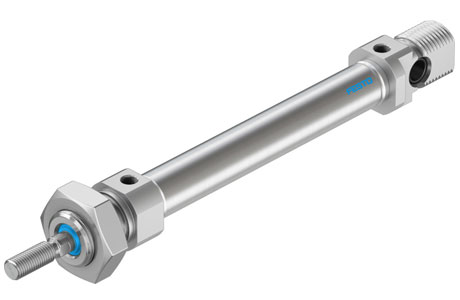
The Festo DSNU-25-30-PPV-A Round Cylinder offers M10x1.25 rod thread, Male thread piston rod end, 25 mm diameter, andPiston; Piston rod; Cylinder barrel. Manufactured by Festo under the Festo Round Cylinder category, this model belongs to the DSNU Series.

| Brand | Festo |
| Product Type | ISO Cylinder |
| Product | DSNU-25-30-PPV-A |
Festo DSNU-25-30-PPV-A Round Cylinder – Technical Specifications
| Specification | Value |
|---|---|
| Stroke | 30 |
| Piston diameter | 25 mm |
| Piston rod thread | M10x1.25 |
| Cushioning | Pneumatic cushioning, adjustable at both ends |
| Mounting position | optional |
| Conforms to standard | CETOP RP 52 P; ISO 6432 |
| Design | Piston; Piston rod; Cylinder barrel |
| Piston-rod end | Male thread |
| Position detection | Via proximity switch |
| Variants | Piston rod at one end |
| Operating pressure | 1; 10 |
| Mode of operation | Double-acting |
| Operating medium | Compressed air to ISO 8573-1:2010 [7:4:4] |
| Corrosion resistance class CRC | 2 - Moderate corrosion stress |
| LABS (PWIS) conformity | VDMA24364-B1/B2-L |
| Cleanroom class | Class 6 according to ISO 14644-1 |
| Ambient temperature | -20; 80 |
| Impact energy in end positions | 0.3 |
| Theoretical force at 0.6 MPa (6 bar, 87 psi), return stroke | 247.4 |
| Theoretical force at 0.6 MPa (6 bar, 87 psi), advance stroke | 294.5 |
| Moving mass for 0 mm stroke | 71 |
| Additional moving mass per 10 mm stroke | 6 |
| Basic weight for 0 mm stroke | 238 |
| Additional weight per 10 mm stroke | 11 |
| Type of mounting | With accessories |
| Pneumatic connection | G1/8 |
| Note on materials | RoHS-compliant |
| Material cover | Wrought aluminium alloy; Colourless anodised |
| Material seals | NBR; TPE-U(PU) |
| Material piston rod | High-alloy stainless steel |
| Material cylinder barrel | High-alloy stainless steel |
| Cushioning length | 17 |
Festo – Precision Pneumatics Trusted by Engineers Worldwide
Festo is a leading name in industrial automation, renowned for its precision, durability, and German engineering excellence. In India, Festo products are widely adopted in industries ranging from automotive to pharmaceuticals and packaging. With an emphasis on quality, innovation, and ease of maintenance, Festo cylinders are preferred by both plant engineers and maintenance teams for their reliability under continuous operation.
DSNU-25-30-PPV-A – Built for Smooth, Adjustable Motion
The DSNU-25-30-PPV-A is a round-type pneumatic cylinder with a 25 mm piston diameter and a 30 mm stroke, designed for double-acting operation. It features adjustable pneumatic cushioning at both ends, allowing engineers to fine-tune the deceleration during piston motion—reducing impact stress and extending service life. The piston rod has an M10x1.25 male thread and supports position detection using proximity sensors, enabling integration into automation systems. Its ISO 6432/CETOP RP 52 P compliance ensures global compatibility, while components like the stainless-steel piston rod and anodized aluminium cover make it corrosion-resistant and suitable for Class 6 cleanroom use. The cylinder weighs just 238 g at 0 mm stroke and is RoHS-compliant, making it both lightweight and environmentally safe.
Where the DSNU-12-70-P-A Shines in Real Applications
The DSNU-12-70-P-A model is often selected for tasks that demand longer linear motion in compact spaces, such as in bottle labeling machines, small pick-and-place setups, or electronics assembly lines. Its 12 mm piston diameter ensures precise control with lower air consumption, making it ideal for lighter loads. Maintenance engineers appreciate its dependable performance and ease of installation with standard mounting accessories. For engineering students, this model is commonly used in training rigs to demonstrate how pneumatic principles work in real-world automation—particularly where stroke length, sensor feedback, and cushioning play a crucial role in system timing and efficiency.
Related Products