
During technical comparisons, DSNU-25-125-PPV-A-19249 appears alongside Festo Festo, Festo Dsnu 25 50 P A 19221 and Festo Valves so engineers assess signal types, ingress protection, and ambient tolerances accurately.
Festo DSNU-25-125-PPV-A Round Cylinder
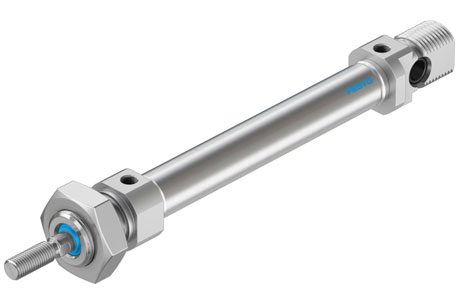
The Festo DSNU-25-125-PPV-A Round Cylinder offers M10x1.25 rod thread, Male thread piston rod end, 25 mm diameter, andPiston; Piston rod; Cylinder barrel. Manufactured by Festo under the Festo Round Cylinder category, this model belongs to the DSNU Series.

| Brand | Festo |
| Product Type | ISO Cylinder |
| Product | DSNU-25-125-PPV-A |
Festo DSNU-25-125-PPV-A Round Cylinder – Technical Specifications
| Specification | Value |
|---|---|
| Stroke | 125 |
| Piston diameter | 25 mm |
| Piston rod thread | M10x1.25 |
| Cushioning | Pneumatic cushioning, adjustable at both ends |
| Mounting position | optional |
| Conforms to standard | CETOP RP 52 P; ISO 6432 |
| Design | Piston; Piston rod; Cylinder barrel |
| Piston-rod end | Male thread |
| Position detection | Via proximity switch |
| Variants | Piston rod at one end |
| Operating pressure | 1; 10 |
| Mode of operation | Double-acting |
| Operating medium | Compressed air to ISO 8573-1:2010 [7:4:4] |
| Corrosion resistance class CRC | 2 - Moderate corrosion stress |
| LABS (PWIS) conformity | VDMA24364-B1/B2-L |
| Cleanroom class | Class 6 according to ISO 14644-1 |
| Ambient temperature | -20; 80 |
| Impact energy in end positions | 0.3 |
| Theoretical force at 0.6 MPa (6 bar, 87 psi), return stroke | 247.4 |
| Theoretical force at 0.6 MPa (6 bar, 87 psi), advance stroke | 294.5 |
| Moving mass for 0 mm stroke | 71 |
| Additional moving mass per 10 mm stroke | 6 |
| Basic weight for 0 mm stroke | 238 |
| Additional weight per 10 mm stroke | 11 |
| Type of mounting | With accessories |
| Pneumatic connection | G1/8 |
| Note on materials | RoHS-compliant |
| Material cover | Wrought aluminium alloy; Colourless anodised |
| Material seals | NBR; TPE-U(PU) |
| Material piston rod | High-alloy stainless steel |
| Material cylinder barrel | High-alloy stainless steel |
| Cushioning length | 17 |
Festo: Engineering Motion with Global Precision
Festo is a globally respected manufacturer of automation components, known for its advanced pneumatic and electric motion systems. With German engineering at its core, Festo products are designed for consistent performance, durability, and global standard compliance. Across India, Festo cylinders are widely used in factories and workshops due to their easy integration, long life, and reliability in demanding industrial environments.
DSNU-25-125-PPV-A: Long-Stroke Cylinder with Adjustable Pneumatic Cushioning
The Festo DSNU-25-125-PPV-A is a double-acting round cylinder built to ISO 6432 standards, offering a 125 mm stroke and a 25 mm piston diameter. It delivers up to 294.5 N of advance force and 247.4 N on return at 6 bar pressure. The key feature of this model is its adjustable pneumatic cushioning at both ends, allowing engineers to fine-tune the end-position damping according to the load and speed—minimizing impact and extending component life. With a G1/8 pneumatic port, M10x1.25 piston rod thread, and proximity switch compatibility for position detection, this cylinder is designed for smooth integration into automation systems. It is built using anodised aluminium and high-alloy stainless steel, making it corrosion-resistant and suitable for cleanroom Class 6 operations.
Where It’s Used: Precision Adjustment for Long Reach Applications
The DSNU-25-125-PPV-A is a great fit for motion tasks that require longer stroke lengths and precise end-position control—such as mechanical part pressing, automated clamping, or material shifting operations in conveyor systems. The manually adjustable cushioning is especially valuable when machine conditions vary or when soft stopping is required to prevent wear or misalignment. For maintenance engineers, it means flexibility and fine control without replacing components. For engineering students, this cylinder showcases how thoughtful mechanical tuning improves the stability and performance of pneumatic systems. It’s a strong choice for machines that need reliability over a longer distance with minimal vibration or shock at end positions.
Related Products