Procurement teams shortlist DSNU-20-10-P-A-19207 with Festo Festo, Festo Dsnu 25 50 P A 19221 and Festo Valves, aligning budget approvals, warranty terms, and multisite availability for smoother rollout across plants.
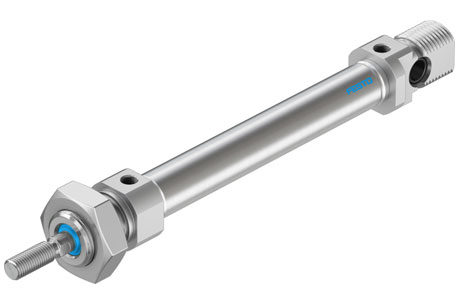
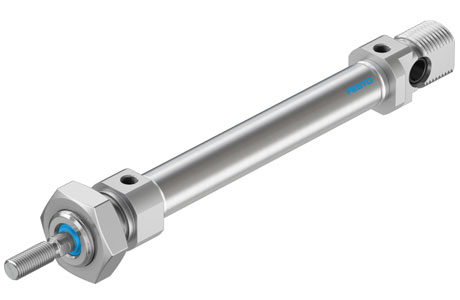
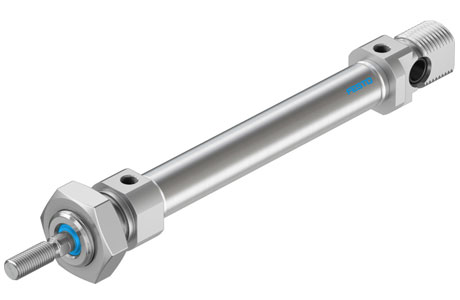
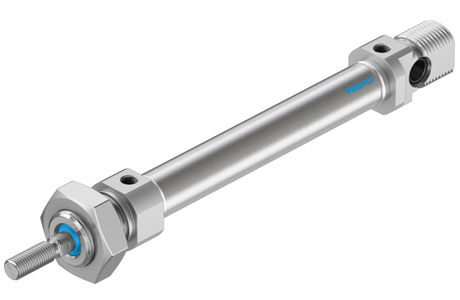
Festo DSNU-20-10-P-A Round Cylinder
The Festo DSNU-20-10-P-A Round Cylinder offers M8 rod thread, Male thread piston rod end, 20 mm diameter, andPiston; Piston rod; Cylinder barrel. Manufactured by Festo under the Festo Round Cylinder category, this model belongs to the DSNU Series.

| Brand | Festo |
| Product Type | ISO Cylinder |
| Product | DSNU-20-10-P-A |
Festo DSNU-20-10-P-A Round Cylinder – Technical Specifications
| Specification | Value |
|---|---|
| Stroke | 10 |
| Piston diameter | 20 mm |
| Piston rod thread | M8 |
| Cushioning | Elastic cushioning rings/plates at both ends |
| Mounting position | optional |
| Conforms to standard | CETOP RP 52 P; ISO 6432 |
| Design | Piston; Piston rod; Cylinder barrel |
| Piston-rod end | Male thread |
| Position detection | Via proximity switch |
| Variants | Piston rod at one end |
| Operating pressure | 1; 10 |
| Mode of operation | Double-acting |
| Operating medium | Compressed air to ISO 8573-1:2010 [7:4:4] |
| Corrosion resistance class CRC | 2 - Moderate corrosion stress |
| LABS (PWIS) conformity | VDMA24364-B1/B2-L |
| Cleanroom class | Class 6 according to ISO 14644-1 |
| Ambient temperature | -20; 80 |
| Impact energy in end positions | 0.2 |
| Theoretical force at 0.6 MPa (6 bar, 87 psi), return stroke | 158.3 |
| Theoretical force at 0.6 MPa (6 bar, 87 psi), advance stroke | 188.5 |
| Moving mass for 0 mm stroke | 44 |
| Additional moving mass per 10 mm stroke | 4 |
| Basic weight for 0 mm stroke | 186.8 |
| Additional weight per 10 mm stroke | 7.2 |
| Type of mounting | With accessories |
| Pneumatic connection | G1/8 |
| Note on materials | RoHS-compliant |
| Material cover | Wrought aluminium alloy; Colourless anodised |
| Material seals | NBR; TPE-U(PU) |
| Material piston rod | High-alloy stainless steel |
| Material cylinder barrel | High-alloy stainless steel |
Festo – Trusted Global Leader in Pneumatic Automation
Festo is a globally recognized name in industrial automation, trusted by engineers and maintenance professionals for its high-quality pneumatic and electromechanical components. Known for German precision and innovation, Festo products are widely used in Indian factories across sectors like automotive, pharmaceuticals, packaging, and food processing. What makes Festo stand out is its consistent performance, long service life, and technical compatibility with modern as well as legacy systems—making it the first choice for both design engineers and plant maintenance teams.
DSNU-20-10-P-A – Compact Cylinder for Quick Actuation
The DSNU-20-10-P-A is a compact double-acting pneumatic round cylinder with a 10 mm stroke and a 20 mm piston diameter. Despite its short stroke, it generates substantial force—188.5 N on the advance stroke and 158.3 N on the return, when operated at 6 bar pressure. This makes it highly effective for fast, controlled movements over short distances. The cylinder uses elastic cushioning rings on both ends to absorb energy during travel and minimize mechanical wear.
It is designed according to ISO 6432 standards, ensuring compatibility with global mounting and accessory options. The cylinder includes a G1/8” pneumatic port, M8 piston rod thread, and supports position detection via proximity switches. It is constructed using high-alloy stainless steel for the piston rod and anodised aluminium for the barrel, offering a corrosion resistance class CRC 2. Its operating temperature range of -20°C to +80°C makes it reliable in diverse industrial environments.
Application Insight – Festo DSNU-12-70-P-A in Indian Industry
The Festo DSNU-12-70-P-A is a commonly used pneumatic cylinder for precise actuation tasks in Indian factories. With a stroke of 70 mm, it is ideal for pushing, ejecting, lifting, or clamping small parts. For instance, in an electronics assembly line, it can gently push PCBs onto conveyor trays without damaging them. In machine panels, it is often used to operate doors or interlocks where short, controlled movements are needed with accurate repeatability.
One of the main reasons engineers prefer this model is the balance it strikes between compact design and reliable force output. It’s easy to install with standard mounting kits, and thanks to position sensing capability, it can be integrated with PLCs for better automation control. Even students in engineering colleges use this model in pneumatics labs to learn motion control principles, pressure-force calculations, and the role of air cushioning. Its reliability and ease of use make it a perfect example of practical engineering in real-world automation systems.