


Maintenance teams planning replacements for DSNU-16-200-P-A-19206 frequently review Festo Festo, Festo Dsnu 25 50 P A 19221 and Festo Valves to prevent downtime, checking availability and compatibility with existing systems.
Festo DSNU-16-200-P-A Round Cylinder
The Festo DSNU-16-200-P-A Round Cylinder offers M6 rod thread, Male thread piston rod end, 16 mm diameter, andPiston; Piston rod; Cylinder barrel. Manufactured by Festo under the Festo Round Cylinder category, this model belongs to the DSNU Series.
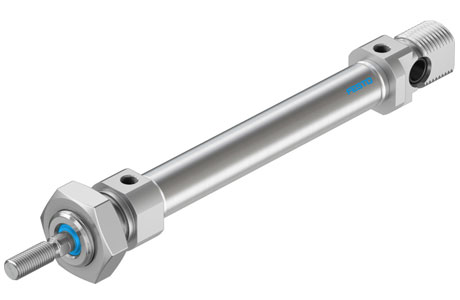
| Brand | Festo |
| Product Type | ISO Cylinder |
| Product | DSNU-16-200-P-A |
Festo DSNU-16-200-P-A Round Cylinder – Technical Specifications
| Specification | Value |
|---|---|
| Stroke | 200 |
| Piston diameter | 16 mm |
| Piston rod thread | M6 |
| Cushioning | Elastic cushioning rings/plates at both ends |
| Mounting position | optional |
| Conforms to standard | CETOP RP 52 P; ISO 6432 |
| Design | Piston; Piston rod; Cylinder barrel |
| Piston-rod end | Male thread |
| Position detection | Via proximity switch |
| Variants | Piston rod at one end |
| Symbol | 991217 |
| Operating pressure | 1; 10 |
| Mode of operation | Double-acting |
| Operating medium | Compressed air to ISO 8573-1:2010 [7:4:4] |
| Corrosion resistance class CRC | 2 - Moderate corrosion stress |
| LABS (PWIS) conformity | VDMA24364-B1/B2-L |
| Cleanroom class | Class 6 according to ISO 14644-1 |
| Ambient temperature | -20; 80 |
| Impact energy in end positions | 0.15 |
| Theoretical force at 0.6 MPa (6 bar, 87 psi), return stroke | 103.7 |
| Theoretical force at 0.6 MPa (6 bar, 87 psi), advance stroke | 120.6 |
| Moving mass for 0 mm stroke | 23 |
| Additional moving mass per 10 mm stroke | 2 |
| Basic weight for 0 mm stroke | 89.9 |
| Additional weight per 10 mm stroke | 4.6 |
| Type of mounting | With accessories |
| Pneumatic connection | M5 |
| Note on materials | RoHS-compliant |
| Material cover | Wrought aluminium alloy; Colourless anodised |
| Material seals | NBR; TPE-U(PU) |
| Material piston rod | High-alloy stainless steel |
| Material cylinder barrel | High-alloy stainless steel |
Festo – Global Leader in Pneumatic Automation
Festo is a German engineering company trusted across industries for its innovation in factory automation, pneumatic systems, and motion control. In India, Festo has built a strong reputation among maintenance engineers and plant heads for delivering products that combine German precision with industrial robustness. Their pneumatic cylinders are widely used in both standard and custom automation setups, known for high reliability, energy efficiency, and ease of maintenance.
DSNU-16-200-P-A – Compact Cylinder for Smooth, Reliable Actuation
The DSNU-16-200-P-A is a double-acting pneumatic cylinder designed for efficient linear motion in industrial machinery. It conforms to the ISO 6432 standard and features a 16 mm piston diameter with a 200 mm stroke. Built for compressed air operation between 1 and 10 bar, this model includes elastic cushioning rings/plates at both ends, which help reduce noise and absorb end-position impacts.
Its design includes a piston rod with male thread, M5 pneumatic connection, and stainless-steel cylinder barrel for enhanced durability in moderate corrosion environments (CRC class 2). Position detection via proximity switches enables easy integration into automated systems. The unit is RoHS-compliant, cleanroom-rated (Class 6), and offers theoretical advance and return forces of 120.6 N and 103.7 N, respectively, at 6 bar. Its mounting flexibility and compact size make it ideal for installations where space and precision matter.
Applications of DSNU-12-70-P-A – Ideal for Compact, Precision Movements
The DSNU-12-70-P-A is widely used in Indian factories for tasks that require light-duty linear movement in limited spaces. Its 12 mm piston diameter and 70 mm stroke offer just the right balance for precise applications such as small object pushing, gate opening, part separation, and sensor-triggered actuation on conveyors or jigs.
Maintenance teams prefer this model for machines where minimal air consumption and fast response are critical. It is also useful in clean environments like electronics assembly lines or pharmaceutical packing, where consistent force and reliability are required without oil-based contaminants. Engineering students studying automation often encounter this model during lab sessions or internships, as it is a textbook example of how smart pneumatic design enables simple yet reliable motion control. Its ability to work silently and smoothly makes it a top choice in systems that run continuously with minimal manual intervention.
Related Products