
Banner Fiber Optic Sensor: Fiber Optic Amplifier
Banner fiber optic sensors perform light-based detection through remote fiber paths configured for confined or high-precision industrial applications today. The Banner Fiber Optic Sensor, manufactured by Banner, uses LED light sources, discrete NPN or PNP outputs, and amplifier units that drive plastic or glass fiber cables for detecting small objects or features in constrained spaces. Category-wide attributes include defined sensing thresholds, selectable light-on or dark-on modes, mechanical housings with DIN-rail or panel mounting, and cable or connector terminations referenced through the Banner Sensors page.
As an identifiable sensing entity, a Banner fiber optic sensor functions as an optoelectronic detection technology structured as a remote-path solid-state device classified under light-transmission sensors and interfaced through discrete signal outputs. These sensors maintain operational stability within manufacturer-specified optical, electrical, and environmental tolerances that define their measurement integrity across diverse industrial automation settings used in India for consistent, reliable object detection tasks daily.
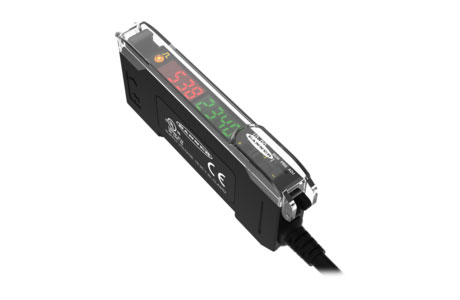
Banner Fiber Optic Sensor: DF-G3 Series
- IO-Link Capability: For advanced communication.
- Long-Range Sensing: Over 3 meters.
- Dual Digital Displays: For signal level and threshold.
- High-Power Amplifier: Precise positioning with small core fibers.
- Adjustable Sensitivity: Enhanced detection control.
- Output Options: Analog, discrete, dual discrete.
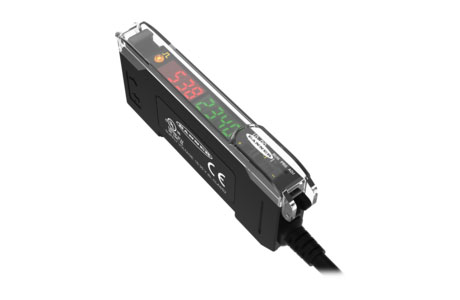
Banner Fiber Optic Amplifier: DF-G1 Series
- IO-Link Capability: For general purpose and error-proofing.
- Output: NPN or PNP options; Fast Response: Up to 200 µs.
- Dual Digital Displays: Simultaneous signal level and threshold display.
- Thermal Stability: Reduces warm-up drift.
- Power Efficiency: ECO mode cuts power consumption by 25%.
- Cross Talk Avoidance: Enables proximity operation of multiple units.
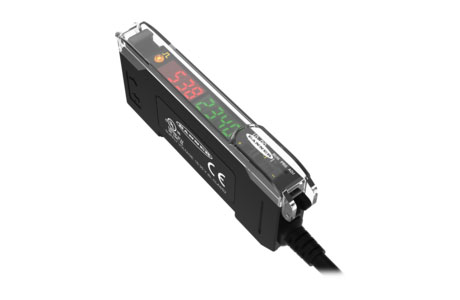
Banner Fiber Amplifiers: DF-G2 Series
- Fast Response: 10 µs response time with 5 µs repeatability.
- IO-Link Capability: For advanced communication and configuration.
- Dual Digital Displays: For signal level and threshold.
- Thermal Stability: Ensures consistent performance.
- Economy Mode: Reduces power consumption by 25%.
- Cross Talk Avoidance: Suitable for dense sensor setups.
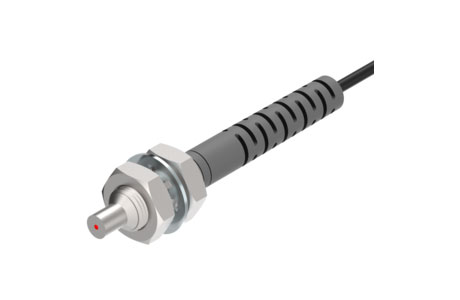
Banner Fiber Sensors: Inline
- Material: Plastic and glass fiber options.
- Core Diameter: Ranges from 0.25 mm to 1.5 mm.
- Fiber Length: Typically 2 meters, with some variations.
- Types: Include diffuse reflective, opposed mode, and retroreflective.
- Thread Options: Various threading for different mounting needs.
- Special Features: Some fibers have flex relief, SteelSkin, or chemical resistance.
- Cutting: Most fibers are free-cut for customization.

Banner Fiber Optic Sensors: Angle
- 90-Degree Angle Bend: Space-saving design for tight installations.
- Sheathing Options: Standard, Dura-Bend, and Steel-Skin.
- Core Diameter: Various sizes available.
- Fiber Length: Typically 2 meters, with some variations.
- Mounting: Easy installation with a single nut.
- Types: Include side exit, flat pack, and threaded options.
- Material: Primarily plastic fibers.
Product List:
| Model No | Image | Housing Style | Fiber Type | Input | Output | Connection |
|---|---|---|---|---|---|---|
| DF-G2-PC-Q7 | 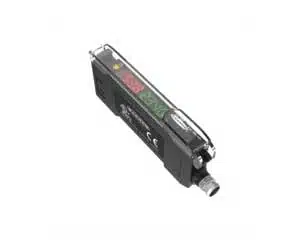 |
DIN Rail | Plastic and Glass | Discrete | PNP | Integral QD |
| DF-G1-PS-2M |  |
DIN Rail | Plastic and Glass | Discrete | PNP | Cable |
| DF-G1-PS-Q7 |  |
DIN Rail | Plastic and Glass | Discrete | PNP | Integral QD |
| DF-G3-PU-Q5 |  |
DIN Rail | Plastic and Glass | Analog & Discrete | PNP | Pigtail QD |
Frequently Asked Questions
What is the Difference Between an Optical Sensor and a Fiber Optic Sensor?
The difference between an optical sensor and a fiber optic sensor lies in their design and application. Optical sensors detect light or changes in light intensity, often used in ambient light sensing.
Fiber optic sensors use optical fibers to detect changes in light transmitted through them, ideal for remote or hazardous environments due to their high sensitivity and resistance to electromagnetic interference.
How do you Amplify a Fiber Optic Signal?
This process boosts the signal strength without converting it to electrical form, maintaining signal integrity over long distances.
How does a Fiber Amplifier Work?
This process strengthens the signal without converting it to electrical form, allowing for long-distance transmission with minimal loss.
What is the Basic Principle of Optical Amplifiers?
The basic principle of an optical amplifier is to boost the intensity of light signals without converting them to electrical signals. It uses a doped fiber, like erbium-doped fiber, and a pump laser.
The pump laser excites the dopant ions, which then amplify the incoming optical signal through stimulated emission, enhancing the signal strength for long-distance transmission.
Get the Best Discounts on Banner Fiber Optic Sensor. Call Now: +91 79955 44066