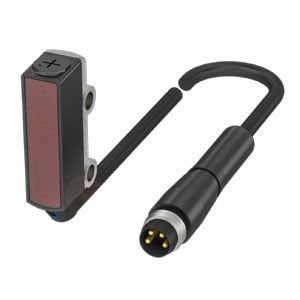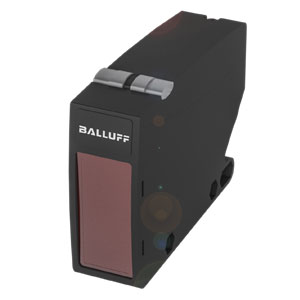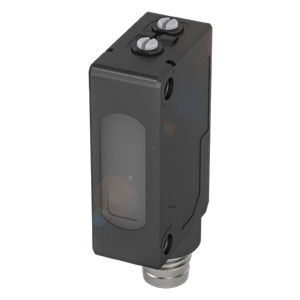
Baluff BOS R81K-PA-RD10-S4 Photoelectric Sensor
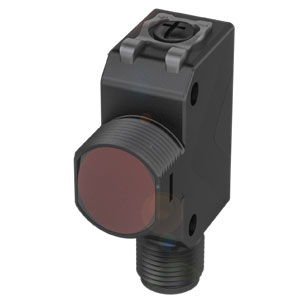
The Baluff BOS R81K-PA-RD10-S4 Photoelectric Sensor offers 5...300 mm sensing range with red LED diffuse detection for compact automation tasks. As part of the Baluff photoelectric sensors portfolio, it provides PNP NO/NC switching in a 15 x 48.9 x 31 mm housing.
This model uses an ABS/PMMA body, an M12 4-pin connector, and a 10...30 VDC operating supply. Its 18 x 18 mm light spot at 300 mm ensures stable detection performance, meeting CE, UKCA, cULus, and WEEE conformity.
| Brand | Balluff |
| Product Type | Photoelectric Sensor |
| Model Number | BOS R81K-PA-RD10-S4 |
Baluff BOS R81K-PA-RD10-S4 Photoelectric Sensor – Technical Specifications
| Specification | Value |
|---|---|
| Series | R81K |
| Dimension | 15 x 48.9 x 31 mm |
| Interface | PNP normally open (NO), normally closed (NC) |
| Principle of operation | Photoelectric sensor |
| Principle of optical operation | Diffuse sensor |
| Special optical feature | - |
| Beam characteristic | - |
| Light type | LED, red light |
| Light spot size | 18 x 18 mm at 300 mm |
| Range | 5...300 mm |
| Connection | Connector, M12x1-Male, 4-pin |
| Housing material | ABS, PMMA |
| Material sensing surface | PMMA |
| Operating voltage Ub | 10...30 VDC |
| Approval/ Conformity | CE, cULus, WEEE, UKCA |
The Baluff BOS R81K-PA-RD10-S4 Photoelectric Sensor combines a 5...300 mm detection range, red LED light source, and a PNP NO/NC interface for consistent diffuse sensing. The BOS R81K-PA-RD10-S4 fits within the BOS series and provides reliable optical performance for general-purpose industrial automation requirements.
In conveyors, packaging machinery, and assembly systems, the Baluff BOS R81K-PA-RD10-S4 Photoelectric Sensor ensures stable detection across varied surfaces. Its compact form, M12 connection, and defined 18 x 18 mm light spot at 300 mm support applications where space efficiency and dependable output switching are essential.
The Baluff BOS R81K-PA-RD10-S4 Photoelectric Sensor delivers repeatable performance supported by durable ABS construction and compliant electrical operation. Engineers value its consistent diffuse sensing behavior, making it suitable for short-range detection tasks requiring trusted, cycle-to-cycle stability within automated processes.