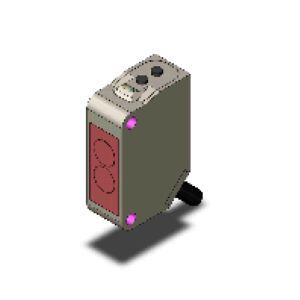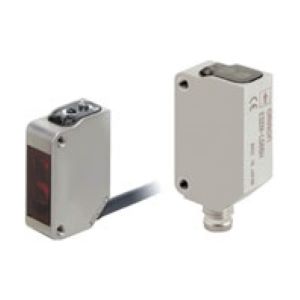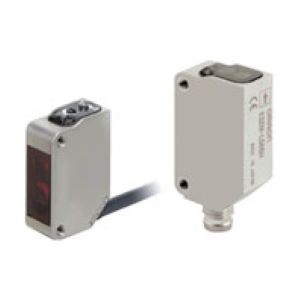
Omron E3ZM-LS86H Photoelectric Sensor
Omron E3ZM-LS86H is a fixed-distance BGS reflective photoelectric sensor specified for sensing from 10 to 100 mm using 100 × 100 mm white paper as the reference target. Its 650 nm red LED supplies the optical source, while background suppression helps limit the influence of surfaces beyond the intended sensing position. A PNP output communicates the switching state to compatible industrial control circuitry, while Light-ON or Dark-ON operation is selectable through the cable connection. The sensor operates from 10 to 30 VDC, consumes up to 25 mA, and uses an M8 4-pin connector for electrical integration. Response time is specified at 1 ms maximum. The E3ZM-LS86H provides connector wiring within the fixed-distance BGS sensor range across Omron Industrial Sensors.
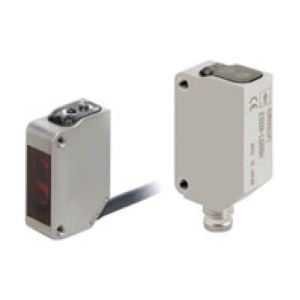
| Brand | Omron |
| Product | Photoelectric Sensors |
| Model Number | E3ZM-LS86H |
Omron E3ZM-LS86H Photoelectric Sensor – Technical Specifications
| Specification | Value |
|---|---|
| Sensing Method | BGS reflective (fixed distance) |
| Sensing Distance | 10 to 100 mm (White paper 100 × 100 mm) |
| Light Source | Red LED (650 nm) |
| Power Supply Voltage | 10 to 30 VDC |
| Output Configuration | PNP |
| Connection Method | Connector type (M8, 4 pins) |
| Current Consumption | 25 mA max. |
| Control Output | Load power supply voltage: 30 VDC max., Load current: 100 mA max. (Residual voltage: 2 V max.) |
| Operation Mode | Light-ON/Dark-ON cable connection selectable |
| Response Time | Operate or reset: 1 ms max. |
| Indicators | Operation indicator (yellow), Stability indicator (green |
| Ambient Illumination | Incandescent lamp: 3,000 lx max. Sunlight 10,000 lx max. |
| Ambient Temperature Range | Operating: -25°C to 55°C, Storage: -40°C to 70°C (with no icing or condensation) |
| Ambient Humidity Range | Operating: 35% to 85%, Storage: 35% to 95% (with no condensation) |
| Insulation Resistance | 20 MΩ min. at 500 VDC |
| Dielectric Strength | 1,000 VAC at 50/60 Hz for 1 minute |
| Vibration Resistance | Destruction: 10 to 55 Hz, 1.5 mm double amplitude for 2 hours each in X, Y, and Z directions |
| Shock Resistance | Destruction: 500 m/s2 3 times each in X, Y, and Z directions |
| Protection Circuits | Reversed power supply polarity protection, Output short-circuit protection, Reversed output polarity protection, Mutual interference protection |
| Degree Of Protection | IEC: IP67, DIN 40050-9: IP69K |
| Material | SUS316, Methacrylic resin, PES (polyether sulfone), PEEK (polyether ether ketone), Fluoro rubber |
| Weight | Approx. 40 g |
The Omron E3ZM-LS86H Photoelectric Sensor uses fixed-distance BGS reflective sensing from 10 to 100 mm, with 100 × 100 mm white paper specified as the reference target. Its 650 nm red LED directs light toward the sensing area, while background suppression helps reduce response from surfaces beyond the selected position. The PNP output supports compatible industrial control circuitry, with load supply voltage specified up to 30 VDC and load current up to 100 mA. The sensor itself operates from 10 to 30 VDC and consumes up to 25 mA. Light-ON or Dark-ON operation is selected through the cable connection, while operate or reset time is 1 ms maximum. An M8 4-pin connector provides removable electrical integration, and yellow operation and green stability indicators provide visual status.
For an Omron fixed-distance BGS sensor requiring PNP output, a 100 mm maximum sensing span, and connector wiring, the relevant model is the E3ZM-LS86H. Operating temperature is specified from -25 to 55°C, with storage extending from -40 to 70°C. Protection functions include reversed supply polarity, output short-circuit, reversed output polarity, and mutual-interference protection. SUS316, methacrylic resin, PES, PEEK, and fluoro rubber are listed among the materials. The M8 interface separates this configuration from pre-wired LS81H variants, while the fixed-distance BGS specification defines the optical arrangement. For a related PNP model providing a wider 10 to 200 mm fixed-distance range, see E3ZM-LS89H.