During technical comparisons, DSNU-40-100-PPS-A appears alongside Festo Festo, Festo Dsnu 25 50 P A 19221 and Festo Valves so engineers assess signal types, ingress protection, and ambient tolerances accurately.
Festo DSNU-40-100-PPS-A Round Cylinder
The Festo DSNU-40-100-PPS-A Round Cylinder offers M12x1.25 rod thread, piston rod end, 40 mm diameter, andPiston; Piston rod; Cylinder barrel. Manufactured by Festo under the Festo Round Cylinder category, this model belongs to the DSNU Series.
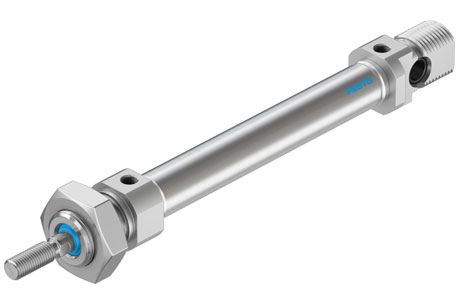
| Brand | Festo |
| Product Type | ISO Cylinder |
| Product | DSNU-40-100-PPS-A |
Festo DSNU-40-100-PPS-A Round Cylinder – Technical Specifications
| Specification | Value |
|---|---|
| Stroke | 100 |
| Piston diameter | 40 mm |
| Piston rod thread | M12x1.25 |
| Cushioning | Self-adjusting pneumatic end-position cushioning |
| Mounting position | optional |
| Design | Piston; Piston rod; Cylinder barrel |
| Position detection | Via proximity switch |
| Operating pressure | 1; 10 |
| Mode of operation | Double-acting |
| Operating medium | Compressed air to ISO 8573-1:2010 [7:4:4] |
| Corrosion resistance class CRC | 2 - Moderate corrosion stress |
| LABS (PWIS) conformity | VDMA24364-B1/B2-L |
| Ambient temperature | -20; 80 |
| Theoretical force at 0.6 MPa (6 bar, 87 psi), return stroke | 633.3 |
| Theoretical force at 0.6 MPa (6 bar, 87 psi), advance stroke | 752.9 |
| Type of mounting | With accessories |
| Pneumatic connection | G1/4 |
| Note on materials | RoHS-compliant |
| Material cover | Wrought aluminium alloy |
| Material seals | NBR; TPE-U(PU) |
| Material piston rod | High-alloy steel |
| Material cylinder barrel | High-alloy stainless steel |
| Moving mass | 390 |
| Cushioning length | 18 |
| Product weight | 901 |
Festo – Trusted by Engineers Worldwide
Festo is a leading name in industrial automation, known for its high-precision pneumatic components and German-engineered reliability. Across Indian industries—from automotive plants in Chennai to packaging units in Ahmedabad—Festo cylinders are trusted for their smooth performance, long service life, and easy maintenance. With a strong focus on innovation, Festo supports both modern automated systems and traditional factory setups, making it a preferred choice for engineers and technicians who want reliable motion solutions that just work.
DSNU-40-100-PPS-A – Technical Highlights
The DSNU-40-100-PPS-A is a double-acting pneumatic round cylinder with a stroke length of 100 mm and a piston diameter of 40 mm, making it suitable for medium to heavy-duty linear motion applications. It features self-adjusting pneumatic end-position cushioning, which automatically adapts to changes in load or speed—reducing the need for manual adjustments and ensuring smooth operation every cycle. The piston rod, threaded at M12x1.25, is built from high-alloy steel for strength and durability, while the cylinder barrel is made from high-alloy stainless steel, offering excellent corrosion resistance. This model operates within 1 to 10 bar pressure using compressed air that complies with ISO 8573-1:2010 [7:4:4], and includes position detection via proximity switch for integration into automated feedback systems. It connects easily using a standard G1/4 pneumatic port and comes with optional mounting accessories.
Where You Can Use DSNU-40-100-PPS-A in Real Applications
This cylinder is commonly used in automated machines that require consistent, repeatable linear motion. The self-adjusting cushioning makes it ideal for operations with changing loads—such as pressing units, product ejectors, or clamping mechanisms—where fine control at the end stroke improves both safety and equipment longevity. Its robust construction and corrosion-resistant materials make it suitable for workshops with oil exposure, dusty shop floors, or even moist environments like food processing areas. With a balanced mix of force (advance: 752.9 N, return: 633.3 N at 6 bar) and compact design, it's a go-to cylinder for engineers looking for reliability without complexity. Maintenance teams can trust it for fewer breakdowns, while students can easily understand how cushioning and material selection improve real-world machine performance.
Related Products