

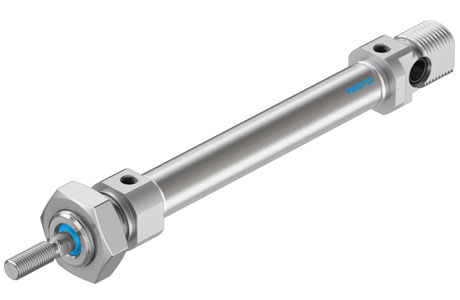

In most procurement cycles, DSNU-25-320-PPV-A-34721 is considered with Festo Festo, Festo Dsnu 25 50 P A 19221 and Festo Valves, giving decision-makers confidence that they’ve chosen the most dependable component.
Festo DSNU-25-320-PPV-A Round Cylinder
The Festo DSNU-25-320-PPV-A Round Cylinder offers M10x1.25 rod thread, Male thread piston rod end, 25 mm diameter, andPiston; Piston rod; Cylinder barrel. Manufactured by Festo under the Festo Round Cylinder category, this model belongs to the DSNU Series.
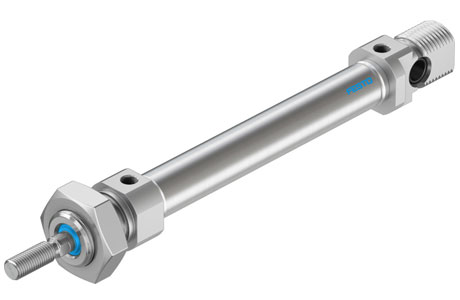
| Brand | Festo |
| Product Type | ISO Cylinder |
| Product | DSNU-25-320-PPV-A |
Festo DSNU-25-320-PPV-A Round Cylinder – Technical Specifications
| Specification | Value |
|---|---|
| Stroke | 320 |
| Piston diameter | 25 mm |
| Piston rod thread | M10x1.25 |
| Cushioning | Pneumatic cushioning, adjustable at both ends |
| Mounting position | optional |
| Conforms to standard | CETOP RP 52 P; ISO 6432 |
| Design | Piston; Piston rod; Cylinder barrel |
| Piston-rod end | Male thread |
| Position detection | Via proximity switch |
| Variants | Piston rod at one end |
| Operating pressure | 1; 10 |
| Mode of operation | Double-acting |
| Operating medium | Compressed air to ISO 8573-1:2010 [7:4:4] |
| Corrosion resistance class CRC | 2 - Moderate corrosion stress |
| LABS (PWIS) conformity | VDMA24364-B1/B2-L |
| Cleanroom class | Class 6 according to ISO 14644-1 |
| Ambient temperature | -20; 80 |
| Impact energy in end positions | 0.3 |
| Theoretical force at 0.6 MPa (6 bar, 87 psi), return stroke | 247.4 |
| Theoretical force at 0.6 MPa (6 bar, 87 psi), advance stroke | 294.5 |
| Moving mass for 0 mm stroke | 71 |
| Additional moving mass per 10 mm stroke | 6 |
| Basic weight for 0 mm stroke | 238 |
| Additional weight per 10 mm stroke | 11 |
| Type of mounting | With accessories |
| Pneumatic connection | G1/8 |
| Note on materials | RoHS-compliant |
| Material cover | Wrought aluminium alloy; Colourless anodised |
| Material seals | NBR; TPE-U(PU) |
| Material piston rod | High-alloy stainless steel |
| Material cylinder barrel | High-alloy stainless steel |
| Cushioning length | 17 |
Festo – Precision Pneumatics Engineered for Reliability
Festo is a globally recognized leader in industrial automation, offering high-performance pneumatic and electrical components. With German engineering at its core, Festo designs products that are reliable, durable, and optimized for automation across various industries. In India, Festo is widely trusted by maintenance teams, system integrators, and OEMs for its commitment to quality, ISO compliance, and consistent innovation.
Technical Overview of DSNU-25-320-PPV-A Cylinder
The DSNU-25-320-PPV-A is a double-acting round cylinder conforming to ISO 6432 standards. With a 25 mm piston diameter and a 320 mm stroke length, it delivers a strong and controlled actuation force of 294.5 N on the forward stroke at 6 bar pressure. This model features adjustable pneumatic cushioning at both ends, allowing technicians to fine-tune deceleration and avoid mechanical shocks, especially in high-speed applications. Its G1/8 pneumatic port, male-threaded piston rod, and modular mounting support make integration simple. Built from high-alloy stainless steel and anodised aluminium, the cylinder is suitable for environments with moderate corrosion stress and supports cleanroom use up to Class 6. The design is RoHS-compliant, easy to maintain, and optimized for long-term usage.
Application Insights – DSNU-12-70-P-A Use Cases
The DSNU-12-70-P-A round cylinder is compact but powerful, often used where space is tight and fast, precise movements are required. In Indian factories, this model is common in semiconductor packaging lines, labelling machines, and mini conveyors. It’s ideal for push-pull mechanisms, small part ejection, and automated test setups. Maintenance engineers favor this cylinder for its simple mounting, low air consumption, and consistent repeatability. For students, this model serves as a hands-on learning example in pneumatic labs, helping them understand double-acting motion control, stroke utilization, and energy efficiency in real-world systems. Its design demonstrates how even a small actuator can play a critical role in automation.
Related Products