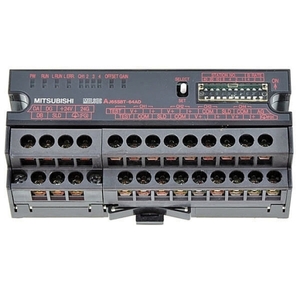
Mitsubishi AJ65SBT2B-64RD3 - PLC Analog Output Module
The Mitsubishi AJ65SBT2B-64RD3 Programmable Logic Controller features 4 RTD input channels compatible with JPT100, NI100, and PT100 sensors for precise temperature measurement. Manufactured by Mitsubishi, it is part of the Mitsubishi Programmable Logic Controller range under the CC-LINK Series. The module operates on a 24V DC power supply, consumes 0.14A current, and has a compact design—50 mm height, 122 mm width, 54 mm depth, and 0.25 kg weight.

| Brand | Mitsubishi |
| Product Type | PLC Analog Output Module |
| Product | AJ65SBT2B-64RD3 |
Mitsubishi PLC Analog Output Module AJ65SBT2B-64RD3 Technical Specifications
| Specification | Value |
|---|---|
| Series | CC-LINK |
| Type | TEMPERATURE INPUT |
| Integrated Analogue Inputs | 4 |
| Int. Current Consumption (A) | 0,14 |
| Depth (mm) | 54 |
| Weight (kg) | 0,25 |
| Width (mm) | 122 |
| Height (mm) | 50 |
| Power Supply (V) | 24 |
| Current Type | DC |
| Input Type | RTD |
| Applicable RTD Type | JPT100, NI100, PT100 |
The Mitsubishi AJ65SBT2B-64RD3 Programmable Logic Controller is a temperature input module from the CC-LINK Series, designed for accurate RTD signal acquisition. It supports 4 input channels for JPT100, NI100, and PT100 sensors, enabling reliable monitoring across distributed control systems. Operating on 24V DC with 0.14A current consumption, this module ensures stable data transmission and efficient thermal process management in automation networks.
The Mitsubishi AJ65SBT2B-64RD3 PLC module is ideal for industrial applications such as temperature control in packaging, molding, and assembly operations. It provides consistent and accurate readings for heat-sensitive environments, making it suitable for remote installations via the CC-LINK communication network. Its compact form factor supports easy integration within complex automation architectures.
The Mitsubishi AJ65SBT2B-64RD3 Programmable Logic Controller combines Mitsubishi’s reliability with distributed control flexibility. Featuring 4 RTD inputs and 24V DC operation, it enables precise temperature data collection within industrial systems. As part of the trusted CC-LINK Series, this model ensures dependable performance and long-term stability in modern factory automation environments.