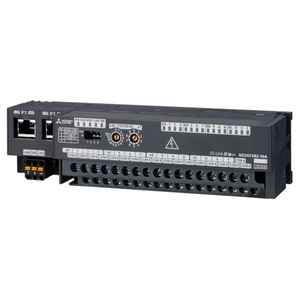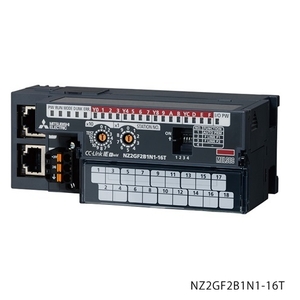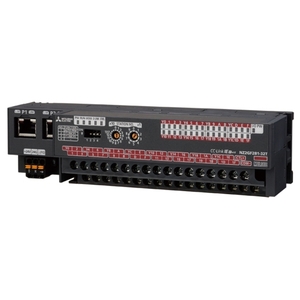
Mitsubishi NZ2GF2B2-16S - Programmable Logic Controller
The Mitsubishi NZ2GF2B2-16S Programmable Logic Controller (PLC) offers high-speed digital I/O performance for modern industrial control systems. Designed by Mitsubishi, this advanced PLC is ideal for scalable machine automation and distributed I/O applications.
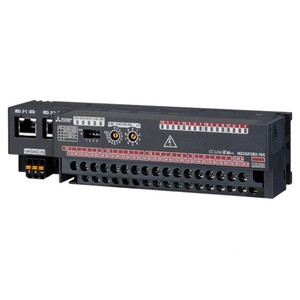
| Brand | Mitsubishi |
| Product Type | PLC(Programmable Logic Controller) |
| Product | NZ2GF2B2-16S |
Technical Specifications of Mitsubishi Programmable Logic Controller NZ2GF2B2-16S
| Specification | Value |
|---|---|
| Series | CC-LINK IE FIELD NETWORK |
| Type | REMOTE TRIAC OUTPUT |
| Depth (mm) | 68 |
| Weight (kg) | 0,45 |
| Width (mm) | 200 |
| Height (mm) | 50 |
| Power Supply (V) | 24 |
| Current Type | DC |
| Integrated Digital Outputs | 16 |
| Output Type | TRIAC |
| Wiring | SCREW |
| Int. Current Consumption (A) | 0,17 |
| Rated Load Voltage (VAC) | 100-240 |
| Occupied Stations | 1 |
The Mitsubishi NZ2GF2B2-16S is a robust remote triac output module from the CC-Link IE Field Network series, offering 16 integrated digital outputs for fast-response control in high-speed automation environments. It supports a wide rated load voltage range of 100–240 VAC, delivering stable output to connected devices such as motors, solenoids, and industrial lighting systems. With a DC power supply of 24V and a low internal current consumption of just 0.17 A, the unit is energy-efficient while supporting heavy-duty tasks with a nominal output current of 2.4 A.
Measuring just 200 mm wide, 68 mm deep, and 50 mm high, and weighing around 0.45 kg, the NZ2GF2B2-16S is compact enough for space-constrained control panels. It is equipped with screw-type wiring terminals for secure installation and features a durable IP20-rated enclosure suitable for cabinet mounting. Designed to operate reliably in harsh conditions, this PLC withstands ambient temperatures from -10°C to 60°C and storage down to -25°C. It meets IEC 60068-2-6 standards for vibration resistance, making it ideal for use in high-vibration production facilities.
Its built-in RJ45 communication port and 2-wire RS-485 interface allow high-speed data transmission across factory networks. The device supports switching frequencies from 2 kHz to 16 kHz, with power dissipation limited to 27 W to maintain thermal efficiency. Rated for use at 50/60 Hz supply frequency, the Mitsubishi NZ2GF2B2-16S PLC is trusted by OEMs and system integrators for long-term reliability and real-time I/O performance.
To learn more or download technical resources, visit the official Mitsubishi product page: Mitsubishi NZ2GF2B2-16S – Official Product Page.
The Mitsubishi NZ2GF2B2-16S PLC is best suited for industrial automation applications that require precise AC signal control, such as batch processing, HVAC systems, packaging lines, and conveyor-based operations. The triac output module allows it to switch high-voltage AC loads with minimal noise and fast response, making it especially useful in environments with high switching demands or motor start-stop sequences.
Indian maintenance engineers and automation technicians benefit from its easy panel integration, thanks to the compact design and screw-terminal wiring. Whether controlling industrial lighting in a smart factory or activating motor drives in food processing plants, this PLC delivers stable operation and supports mission-critical tasks. The vibration-resistant design and wide voltage handling range ensure that the PLC continues functioning even in electrically noisy or unstable supply conditions.
For system integrators managing distributed networks via CC-Link IE Field, the NZ2GF2B2-16S becomes an essential part of modular expansion. It allows scalable automation without compromising response time or output precision. In short, the Mitsubishi NZ2GF2B2-16S PLC is a high-value investment for businesses focused on efficiency, reliability, and long-term industrial performance.