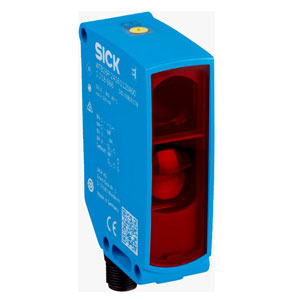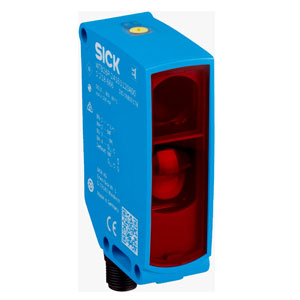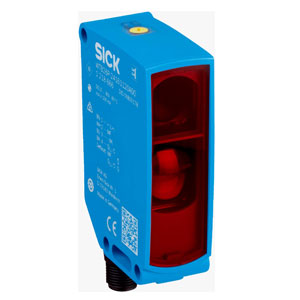
Sick WTS26P-24161120A00 Photoelectric Sensor
The Sick WTS26P-24161120A00 photoelectric sensor uses TwinEye background suppression with 10–1000 mm sensing range and PNP/NPN outputs for automation. This Sick Photoelectric Sensor from the W26 and W16 series operates with PinPoint LED visible red light at 636 nm, supports 10–30 V DC supply, provides 350 Hz switching frequency, and features IP66/IP67/IP69 enclosure with IO-Link adjustment.
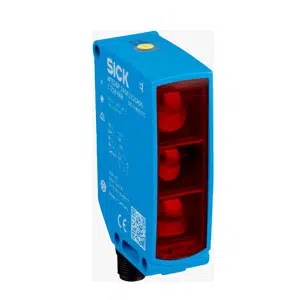
| Brand | Sick |
| Product Type | Photoelectric Sensor |
| Model Number | WTS26P-24161120A00 |
Sick WTS26P-24161120A00 Photoelectric Sensor – Technical Specifications
| Specification | Value |
|---|---|
| Functional principle | Photoelectric proximity sensor |
| Functional principle detail | Background suppression, TwinEye technology |
| Sensing range min. | 10 mm |
| Sensing range max. | 1,000 mm |
| Light source | PinPoint LED |
| Type of light | Visible red light |
| Shape of light spot | Point-shaped |
| Light spot size (distance) | Ø 10 mm (550 mm) |
| Wave length | 636 nm |
| Adjustment | Teach-Turn adjustment, IO-Link |
| Indication | LED blue, LED green, LED yellow |
| Supply voltage UB | 10 V DC ... 30 V DC 1) |
| Ripple | ≤ 5 Vpp |
| Usage category | DC-12 (According to EN 60947-5-2), DC-13 (According to EN 60947-5-2) |
| Current consumption, sender & Receiver | ≤ 30 mA, without load. At UB = 24 V |
| Protection class | III |
| Digital output Number | 2 (Complementary) |
| Output type | Push-pull: PNP/NPN |
| Signal voltage PNP HIGH/LOW | Approx. UB-2.5 V / 0 V |
| Signal voltage NPN HIGH/LOW | Approx. UB / < 2.5 V |
| Output current Imax. | ≤ 100 mA |
| Circuit protection outputs | Reverse polarity protected, Overcurrent and short-circuit protected |
| Response time | ≤ 1.4 ms 2) |
| Repeatability (response time) | 750 µs |
| Switching frequency | 350 Hz 3) |
| Housing | Rectangular |
| Dimensions (W x H x D) | 24.6 mm x 82.5 mm x 53.3 mm |
| Connection | Male connector M12, 4-pin |
| Housing material | Plastic, VISTAL® |
| Front screen material | Plastic, PMMA |
| Male connector material | Plastic, VISTAL® |
| Maximum tightening torque of the fixing screws | 1.3 Nm |
| Enclosure rating | IP66 (EN 60529), IP67 (EN 60529), IP69 (EN 60529) 1) |
| Ambient operating temperature | –40 °C ... +60 °C |
| Ambient temperature, storage | –40 °C ... +75 °C |
| Weight | Approx. 80 g |
The WTS26P-24161120A00 Sick 1000 mm TwinEye Photoelectric Sensor is a photoelectric proximity sensor designed for background suppression in industrial automation. The WTS26P-24161120A00 Sick 1000 mm TwinEye Photoelectric Sensor delivers a 10–1000 mm sensing range, applies TwinEye background suppression, and uses PinPoint LED at 636 nm with PNP/NPN complementary outputs. It belongs to the W26 and W16 series and supports precise object detection in automated systems.
In industrial automation, the WTS26P-24161120A00 Sick 1000 mm TwinEye Photoelectric Sensor is used in conveyors, packaging equipment, assembly lines, and material handling stations. TwinEye technology improves detection reliability on dark, shiny, or irregular objects. Stable outputs and controlled response time enable accurate PLC interfacing in medium-speed production environments.
The WTS26P-24161120A00 Sick 1000 mm TwinEye Photoelectric Sensor combines IP66/IP67/IP69 protection, VISTAL® housing, and an operating range of –40 °C to +60 °C for dependable industrial performance. Electrical protection, defined switching behavior, and repeatability reflect Sick quality standards. The WTS26P-24161120A00 is suitable for consistent photoelectric sensing in demanding automation applications.