
Schneider Contactors - Telemecanique Contactor
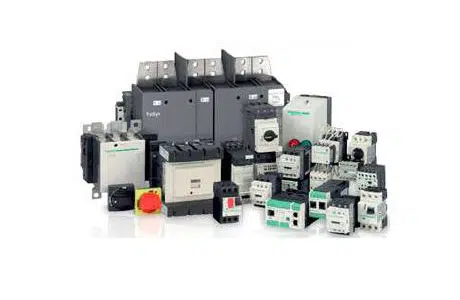
:contentReference[oaicite:0]{index=0} contactors are electromechanical switching devices used to control and isolate electrical power circuits in industrial systems reliably continuously. They use electromagnetic coils to actuate main contacts, enabling frequent switching of motors, heaters, and capacitive loads under defined voltage and current ratings with auxiliary contacts providing status feedback for control circuits and interlocking within standardized industrial power control assemblies across manufacturing process facilities. Selection depends on utilization category, rated operational current, coil control voltage, contact configuration, duty cycle, short circuit coordination, ambient temperature limits, mechanical endurance, electrical endurance, and compliance with IEC and IS standards for safe integration in motor control centers and automation panels. Schneider contactors are coil actuated electromechanical power switching assemblies, panel mounted, classified by utilization category and contact arrangement, interfacing through control voltage coils and mechanical contacts for standardized industrial power control architectures supporting motors, feeders, and resistive loads within low voltage distribution systems across facilities.
Schneider Contactors - TeSys Deca
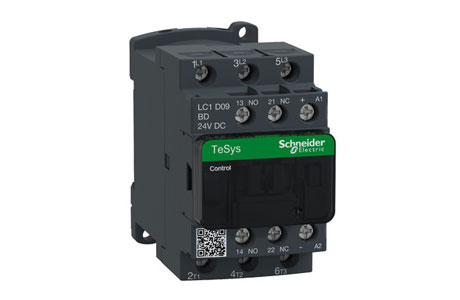
Model Name: Formerly known as TeSys D.
Variety: Available in 3-pole and 4-pole versions.
Applications: Suitable for motor control and resistive load control.
Amperage Ranges: From 9 A to 150 A for motor control; 20 A to 200 A for resistive loads.
Robust Design: Ensures reliability and durability in demanding environments.
Schneider Contactor - TeSys F
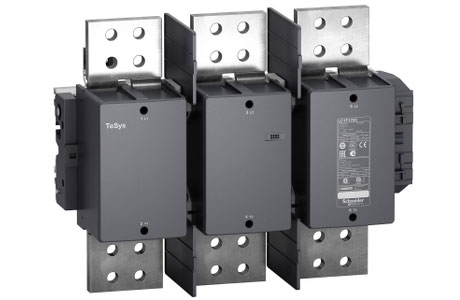
Applications: Designed for controlling up to 450 kW/400 V and 2100 A/AC1.
Variety: Offers a wide range of contactors and reversing contactors.
Versatility: Suitable for diverse industrial applications.
Design: Robust construction ensures durability and reliability in demanding settings.
Schneider Safety Contactor - TeSys K
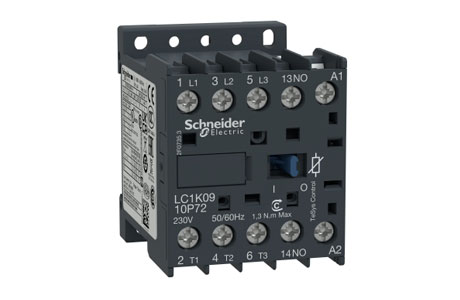
Variety: Available as reversing or non-reversing contactors.
Capacity: Suitable for applications up to 5.5 kW at 400/415 V.
Part of TeSys: Integrates seamlessly with other TeSys products for comprehensive solutions.
Support Options: Sales support available for service and inquiries.
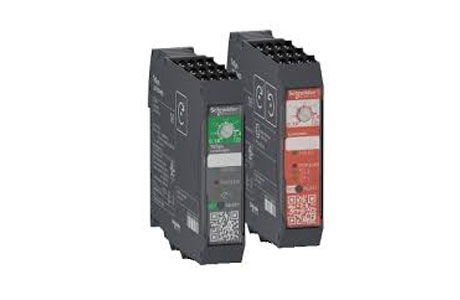
Schneider Electric Contactors: TeSys H
Compact Design: Ultra-compact form factor ideal for space-constrained applications.
Motor Compatibility: Specifically designed for asynchronous motor control.
Functional Integration: Easily integrates into various industrial systems for enhanced operational efficiency.
Reliability: Engineered for reliability in demanding industrial environments.
Support Availability: Comprehensive sales support available for installation and operational inquiries.





United Control Engineers India Pvt Ltd
✔ Verified
Deals in PAN India

Schneider Electric’s range of contactors and protection relays is designed for robust and reliable operation in various industrial settings. These products, which include the TeSys series, are tailored to meet diverse application needs, offering solutions for motor control, load management, and safety. The contactors are available in various models with different amperage ratings and features, ensuring efficient performance and integration across multiple industrial environments.
How does Schneider contactor work?
A Schneider contactor works by creating a circuit connection when activated, closing the pathway between the power source (L1) and the load (L2). This closure allows electrical current to flow through the load, completing the circuit. The contactor effectively acts as a switch, controlled electrically to manage the distribution of power in various applications, from industrial machinery to HVAC systems.
What are the three types of contactors?
There are three primary types of contactors used to control electrical circuits: AC contactor, DC contactor, and magnetic contactor. AC contactors are designed specifically for AC power applications and are commonly used in industrial equipment and HVAC systems. DC contactors are used with DC power sources, ideal for applications like electric vehicle systems and renewable energy installations. Magnetic contactors use an electromagnetic mechanism to open and close circuits, offering robust performance for heavy-duty applications. Each type plays a crucial role in electrical system management and safety.
What is the purpose of 4 pole contactor?
The purpose of a 4 pole contactor is to control multiple lighting circuits simultaneously. This specialized electromechanical device allows for efficient switching and management of lighting setups, facilitating seamless operation across various circuits. It is particularly useful in larger installations where multiple lighting arrays are operated concurrently, enhancing electrical system functionality and safety.
Find the right Schneider Contactors for your industry needs at IndMALL.