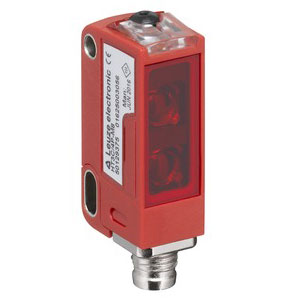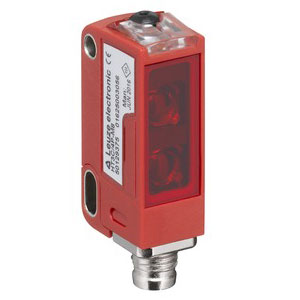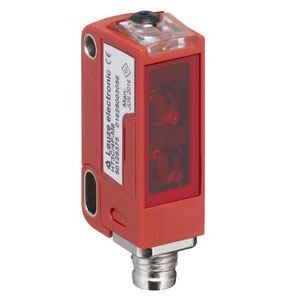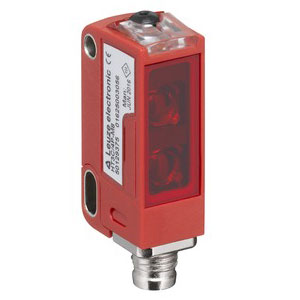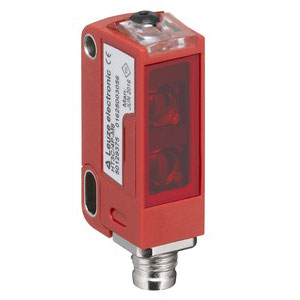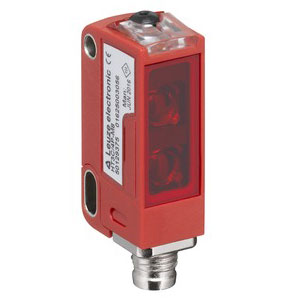
Leuze HT3CL1/4P-M8P1 Photoelectric Sensor
Technical Specifications of Leuze HT3CL1/4P-M8P1 50135543:
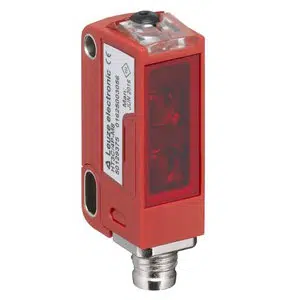
| Brand | Leuze |
| Product Type | Photoelectric Sensor |
| Product | HT3CL1/4P-M8P1 |
Leuze HT3CL1/4P-M8P1 Photoelectric Sensor – Technical Specifications
| Specification | Value |
|---|---|
| Design | Cubic |
| Operating principle | Diffuse reflection principle with background suppression |
| Special version | Suppression of HF illumination (LED) |
| Sensing Distance | 0.015 ... 0.4 m |
| Beam path | Collimated |
| Light source | Laser, Red |
| Wavelength | 650 nm |
| Type of light spot geometry | 1 mm [400 mm] |
| Light spot size [at sensor distance] | Round |
| Measurement range | - |
| Supply voltage UB | 10 ... 30 V, DC, Incl. residual ripple |
| Switching Output 1 | Transistor, PNP |
| Switching principle | Light switching |
| Switching Output 2 | Transistor, PNP |
| Switching principle | Dark switching |
| Switching frequency | 250 Hz |
| Response time | 0.16 ms |
| Function | Signal OUT Voltage supply |
| Type of connection | Connector |
| Thread size | M8 |
| Type | Male |
| Material | Metal |
| No. of pins | 4 -pin |
| Dimension (W x H x L) | 11.4 mm x 34.2 mm x 18.3 mm |
| Housing material | Plastic |
| Plastic housing | PC-ABS |
| Lens cover material | Plastic / PMMA |
| Housing color | Red |
| Type of display | LED |
| Operational controls | Multiturn potentiometer |
| Ambient temperature, operation | -40 ... 55 °C |
| Ambient temperature, storage | -40 ... 70 °C |
| Degree of protection | IP 67/IP 69K |
The Leuze HT3CL1/4P-M8 Photoelectric Sensor features a robust cubic design and operates using the diffuse reflection principle with background suppression, ensuring dependable detection even in environments with reflective or variable backgrounds. Its collimated laser beam offers exceptional detection accuracy, producing a 1 mm light spot at 400 mm distance. This tight beam control makes it ideal for detecting small parts or label edges in fast-moving systems.
Powered by a 10–30 V DC supply and equipped with dual PNP transistor switching outputs for both light and dark switching, the HT3CL1/4P-M8 integrates easily into modern control architectures. With a fast switching frequency of 3,000 Hz and a response time of just 0.16 ms, it supports high-speed processes without missing detection cycles. The sensor includes a standard M8 4-pin male connector for secure connectivity and ease of replacement during maintenance.
Built with durable PC-ABS plastic housing and a protective PMMA lens cover, the sensor withstands harsh industrial conditions. Rated with an impressive IP67/IP69K degree of protection, it can be used in washdown areas or dusty environments. Its wide temperature range from -40°C to +55°C ensures stable performance in both chilled warehouses and warm production lines. For full details, refer to the official Leuze product page or download the HT3CL1/4P-M8 datasheet.
The Leuze HT3CL1/4P-M8 Photoelectric Sensor is ideal for automation tasks that demand high precision in compact spaces. It is commonly used for detecting packages, bottles, labels, and small mechanical parts on conveyors, pick-and-place units, and robotic cells.
Because of its background suppression feature, this sensor eliminates false triggers caused by shiny metallic surfaces or transparent packaging. The red laser beam makes alignment simple and visual during installation, helping engineers save setup time and reduce errors. The multiturn potentiometer allows users to fine-tune the sensing range based on specific application needs.
Whether you're upgrading a legacy detection system or building a new automation cell, the Leuze HT3CL1/4P-M8 Photoelectric Sensor delivers performance, speed, and reliability. Maintenance engineers, system integrators, and OEMs across India trust this photoelectric sensor for its accuracy and ruggedness in real-world factory conditions.