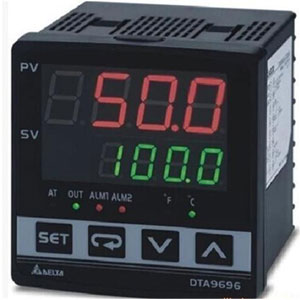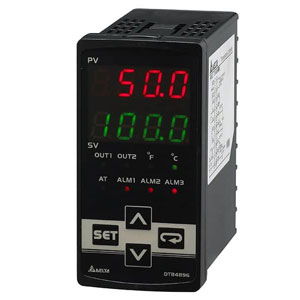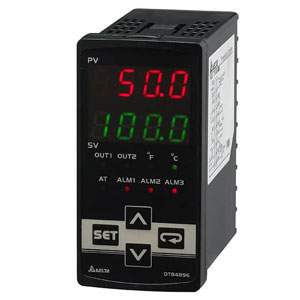
Delta DTB9696CVT Temperature Controllers
Delta DTB9696CVT Temperature Controller is designed for industrial thermal regulation and stable process monitoring applications within automation systems. This 1/4 DIN W96 × H96mm controller supports dependable industrial automation integration through MODBUS ASCII / RTU communication protocol while operating on AC100 ~ 240V, 50/60Hz and DC24V±10% input power. It supports analog input scanning at 150 msec per scan and thermocouple or Platinum RTD response at 400 msec per scan for reliable industrial temperature monitoring performance. Manufactured by Delta Industrial Automation Solutions, part of the Delta Temperature Control Systems family within the Delta DTB Series Controllers.

| Brand | Delta |
| Product Type | Temperature Controller |
| Product | DTB9696CVT |
Delta panel size of 96 x 96 mm Controller DTB9696CVT Technical Specifications:
| Specification | Value |
|---|---|
| Panel Size (W×H) | 1/4 DIN W96 × H96mm |
| Input Voltage | AC100 ~ 240V, 50/60Hz; DC24V±10% |
| Operation Voltage Range | Rated voltage: AC 85% ~ 110%; DC 90 ~ 110% |
| Power Consumption | 5VA max. |
| Memory Protection | EEPROM 4K bit (non-volatile memory (number of writes: 100,000) |
| Display Method | 2 line x 4 character 7-segment LED display Process value (PV): Red color, Set point (SV): Green color |
| Sensor Type | Thermocouple: K, J, T, E, N, R, S, B, L, U, TXK 3-wire Platinum RTD: Pt100, JPt100 Analog input: 0 ~ 5V, 0 ~ 10V, 0 ~ 20 m A, 4 ~ 20 m A, 0 ~ 50mV |
| Control Mode | PID, ON/OFF, Manual or PID program control (Ramp/Soak control) |
| Control Output | Relay output: SPDT (SPST: 1/16 DIN and 1/32 DIN size), Max. load 250VAC, 5A resistive load Voltage pulse output: DC 14V, Max. output current 40mA Current output: DC 4 ~ 20m A output (Load resistance: Max. 600) Linear voltage output: 0 ~ 10V |
| Display Accuracy | 0 or 1 digit to the right of the decimal point (selectable) |
| Sampling Rate | Analog input: 150 msec/ per scan Thermocouple or Platinum RTD: 400 msec/per scan |
| RS-485 Communication | MODBUS ASCII / RTU communication protocol |
| Vibration Resistance | 10 to 55Hz, 10m/s2 for 10min, each in X, Y and Z directions |
| Shock Resistance | Max. 300m/ s2, 3 times in each 3 axes, 6 directions |
| Ambient Temperature | 0oC ~ +50oC |
| Storage Temperature | -20oC ~ +65oC |
| Altitude | 2,000m or less |
| Relative Humidity | 35% ~ 80% (non-condensing) |
| Panel Protection Level | IP65 |
| 1st Output Group Selection | R: Relay output, SPDT (SPST: 1/16 DIN and 1/32 DIN size), 250VAC, 5A V: Voltage pulse output, 14V +10% ~ -20% (Max. 40mA) C: DC current output , 4 ~ 20mA L: Linear voltage output, 0 ~ 10VDC |
| 2nd Output Group Selection | R: Relay output, SPDT (SPST: 1/16 DIN and 1/32 DIN size), 250VAC, 5A V: Voltage pulse output, 14V +10% ~ -20% (Max. 40mA) |
| EVENT inputs / CT function (optional) | None: No EVENT input , No CT (Current transformer) E: EVENT input is provided, No CT (Current transformer) T: CT (Current transformer) is provided, No EVENT input V: Valve control |
The Delta DTB9696CVT temperature controller is commonly used in industrial heating systems, ovens, process machinery, packaging equipment, and automation panels requiring dependable thermal regulation and stable communication-ready monitoring functionality. Its 96 × 96 mm DIN structure supports organized installation within industrial control cabinet environments operating under continuous production conditions.
Industrial systems integrating the Delta DTB9696CVT benefit from dependable industrial operation supported by vibration resistance from 10 to 55Hz across X, Y, and Z directions. The MODBUS ASCII / RTU communication capability enables centralized industrial automation integration for stable process monitoring and reliable temperature management applications.
For industries searching for a Delta Temperature Controller, the Delta DTB9696CVT provides dependable industrial thermal regulation capability, stable thermocouple and Platinum RTD monitoring, and reliable communication integration. Within the Delta DTB Series, it remains a practical solution for industrial automation systems requiring continuous temperature management and dependable process control performance.