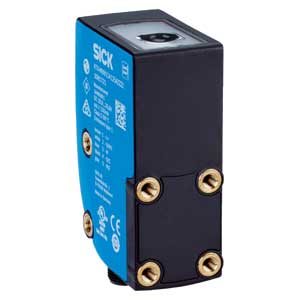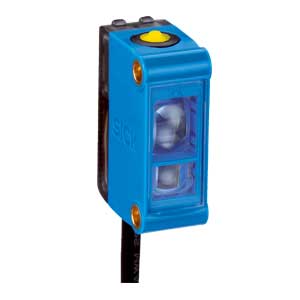
Sick KT8L-P3756 Contrast Sensor
Sick KT8L-P3756 Contrast Sensor delivers ≤ 150 mm sensing distance, 655 nm red laser light, and 30 µs response time performance. This Sick 655 nm Wavelength Contrast Sensor features PNP switching output, IP67 enclosure rating, 10 V DC to 30 V DC supply voltage, large 30.4 mm × 53 mm × 80 mm housing, Ø 3 mm round light spot, teach-in button adjustment, male connector M12 5-pin connection, and belongs to the KT series for industrial automation applications.

| Brand | Sick |
| Product Type | Contrast Sensor |
| Product | KT8L-P3756 |
Sick KT8L-P3756 Contrast Sensor – Technical Specifications
| Specification | Value |
|---|---|
| Dimensions (W x H x D) | 30.4 mm x 53 mm x 80 mm |
| Sensing distance | ≤ 150 mm |
| Sensing distance tolerance | - |
| Housing design | Large |
| Light source | Laser, red 2) |
| Wave length | 655 nm |
| Light spot size | Ø 3 mm 3) |
| Light spot direction | Round |
| Adjustment | Teach-in button |
| Supply voltage | 10 V DC ... 30 V DC |
| Response time | 30 µs 5) |
| Switching output | PNP |
| Switching mode | - |
| Enclosure rating | IP67 |
| Connection type | Male connector M12, 5-pin |
| Ambient operating temperature | –10 °C ... +45 °C |
KT8L-P3756 Sick 655 nm Wavelength Contrast Sensor is designed for precise mark detection in industrial automation systems. The KT8L-P3756 Sick 655 nm Wavelength Contrast Sensor operates with ≤ 150 mm sensing distance, 655 nm red laser light, 30 µs response time, and PNP switching output. It belongs to the KT series and supports stable detection performance under varying material contrasts.
KT8L-P3756 is used in packaging lines, print mark detection, conveyor systems, and assembly automation where accurate contrast differentiation is required. The laser light source with Ø 3 mm spot ensures focused detection over extended sensing distances.
KT8L-P3756 from Sick operates between –10 °C and +45 °C with 10 V DC to 30 V DC supply voltage. As part of the KT series, this Sick contrast sensor integrates into industrial control panels and maintains reliable switching behavior in production environments.