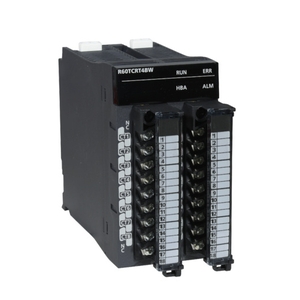
Mitsubishi R60TCRT4BW - PLC Analog Output Module
The Mitsubishi R60TCRT4BW Programmable Logic Controller features 4 temperature control input channels designed for JPT100 and PT100 RTD types used in precision monitoring. Developed by Mitsubishi, it belongs to the Mitsubishi Programmable Logic Controller range within the MELSEC iQ-R Series. The module operates on 24V DC power, consumes 0.34 A current, and has compact dimensions of 56 mm width and 110 mm depth for efficient panel integration.
| Brand | Mitsubishi |
| Product Type | PLC Analog Output Module |
| Product | R60TCRT4BW |
Mitsubishi PLC Analog Output Module R60TCRT4BW Technical Specifications
| Specification | Value |
|---|---|
| Series | MELSEC IQ-R SERIES |
| Type | TEMPERATURE CONTROL |
| Occupied I/O Points on PLC | 32 |
| Integrated Analogue Inputs | 4 |
| Int. Current Consumption (A) | 0,34 |
| Depth (mm) | 110 |
| Weight (kg) | 0,34 |
| Width (mm) | 56 |
| Height (mm) | 98 (106) |
| Input Type | RTD |
| Applicable RTD Type | JPT100, PT100 |
The Mitsubishi R60TCRT4BW Programmable Logic Controller is a temperature control module engineered for precise industrial automation applications. It supports 4 RTD input channels compatible with JPT100 and PT100 sensors and functions on a 24V DC power supply. As a product of the MELSEC iQ-R Series, this Mitsubishi PLC ensures stable performance, accurate temperature input, and reliable process control.
The Mitsubishi R60TCRT4BW PLC is ideal for temperature-regulated automation systems, including process manufacturing, packaging, and assembly lines. Its compact design—56 mm width and 110 mm depth—fits seamlessly into industrial panels. The module’s RTD compatibility enables accurate temperature feedback and dependable operation, ensuring consistent control performance in demanding environments.
The Mitsubishi R60TCRT4BW Programmable Logic Controller upholds Mitsubishi’s reputation for precision and reliability in industrial control systems. Part of the MELSEC iQ-R Series, it delivers long-term stability, accurate signal measurement, and seamless integration in industrial automation setups. Engineers rely on this model for its efficiency, signal accuracy, and dependable temperature management capabilities across automation networks.