
Many engineers reviewing Festo DSNU-20-P-A-14328 also explore Festo Festo, Festo Dsnu 25 50 P A 19221 and Festo Valves, ensuring they don’t miss strong alternatives before finalizing procurement decisions.
Festo DSNU-20- -P-A Round Cylinder
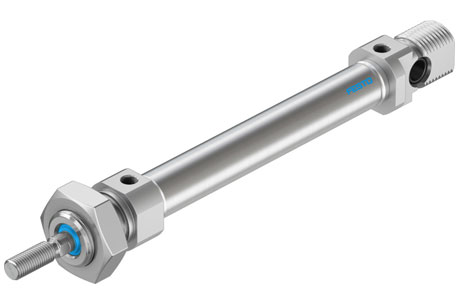
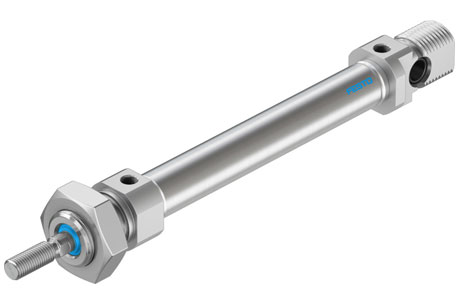
The Festo DSNU-20- -P-A Round Cylinder offers M8 rod thread, Male thread piston rod end, 20 mm diameter, andPiston; Piston rod; Cylinder barrel. Manufactured by Festo under the Festo Round Cylinder category, this model belongs to the DSNU Series.
| Brand | Festo |
| Product Type | ISO Cylinder |
| Product | DSNU-20- -P-A |
Festo DSNU-20- -P-A Round Cylinder – Technical Specifications
| Specification | Value |
|---|---|
| Stroke | 1; 320 |
| Piston diameter | 20 mm |
| Piston rod thread | M8 |
| Cushioning | Elastic cushioning rings/plates at both ends |
| Mounting position | optional |
| Conforms to standard | CETOP RP 52 P; ISO 6432 |
| Design | Piston; Piston rod; Cylinder barrel |
| Piston-rod end | Male thread |
| Position detection | Via proximity switch |
| Variants | Piston rod at one end |
| Operating pressure | 1; 10 |
| Mode of operation | Double-acting |
| Operating medium | Compressed air to ISO 8573-1:2010 [7:4:4] |
| Corrosion resistance class CRC | 2 - Moderate corrosion stress |
| LABS (PWIS) conformity | VDMA24364-B1/B2-L |
| Cleanroom class | Class 6 according to ISO 14644-1 |
| Ambient temperature | -20; 80 |
| Impact energy in end positions | 0.2 |
| Theoretical force at 0.6 MPa (6 bar, 87 psi), return stroke | 158.3 |
| Theoretical force at 0.6 MPa (6 bar, 87 psi), advance stroke | 188.5 |
| Moving mass for 0 mm stroke | 44 |
| Additional moving mass per 10 mm stroke | 4 |
| Basic weight for 0 mm stroke | 186.8 |
| Additional weight per 10 mm stroke | 7.2 |
| Type of mounting | With accessories |
| Pneumatic connection | G1/8 |
| Note on materials | RoHS-compliant |
| Material cover | Wrought aluminium alloy; Colourless anodised |
| Material seals | NBR; TPE-U(PU) |
| Material piston rod | High-alloy stainless steel |
| Material cylinder barrel | High-alloy stainless steel |
Trusted Globally, Built for Precision – Festo’s Engineering Legacy
Festo is a globally respected automation leader known for designing reliable pneumatic and electric solutions trusted by engineers in over 60 countries. Their products are widely used in Indian industries—automotive, pharma, food processing, and general manufacturing—for their consistency, smart design, and global standards. Maintenance engineers and automation teams appreciate Festo for its blend of German engineering precision and real-world reliability, especially in demanding machine environments.
DSNU-20-P-A – Compact Cylinder for Medium Force Applications
The DSNU-20-P-A is a round cylinder with a 20 mm piston diameter and stroke lengths from 1 mm to 320 mm. Built for double-acting operation, this model uses compressed air and operates reliably between 1 to 10 bar pressure. It features elastic cushioning rings at both ends to reduce impact during stroke transitions, enhancing service life.
With an M8 male-threaded piston rod, G1/8” pneumatic connection, and optional mounting accessories, it offers simple installation in tight machine layouts. The materials—high-alloy stainless steel piston rod and aluminium body—are RoHS-compliant and built for moderate corrosion resistance (CRC Class 2). Its cleanroom compatibility (ISO Class 6) and ability to work between -20°C to 80°C make it suitable for both controlled and workshop environments.
How DSNU-12-70-P-A Helps in Real-World Engineering Scenarios
The DSNU-12-70-P-A round cylinder is often used where precise short-stroke linear motion is required. Imagine an automated filling machine, where a nozzle must lower and return with consistent force—or a parts ejection system, where a gentle push is needed every few seconds. This is where the 70 mm stroke length becomes ideal: long enough to handle common mechanical movements, yet compact for tight spaces.
It integrates well with proximity sensors for position feedback and is highly preferred by maintenance teams due to its low maintenance and easy part replacement. Engineering students exploring pneumatics also use such models to learn stroke control, cushioning behavior, and the importance of clean air supply. It’s not just a cylinder—it’s a trusted component that engineers can rely on across machines, panels, and experimental setups.
Related Products