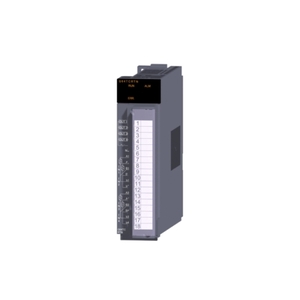
Mitsubishi Q64TDV-GH - PLC Analog Output Module
The Mitsubishi Q64TDV-GH Programmable Logic Controller provides 4 thermocouple inputs supporting T, S, R, N, K, J, E, and B types for precise temperature measurement and control. Designed by Mitsubishi, it belongs to the Mitsubishi Programmable Logic Controller range within the MELSEC-Q Series. The module consumes 0.5A current, occupies 16 I/O points, and delivers stable thermal input performance ideal for industrial automation systems.

| Brand | Mitsubishi |
| Product Type | PLC Analog Output Module |
| Product | Q64TDV-GH |
Mitsubishi PLC Analog Output Module Q64TDV-GH Technical Specifications
| Specification | Value |
|---|---|
| Series | MELSEC-Q SERIES |
| Type | TEMPERATURE INPUT |
| Occupied I/O Points on PLC | 16 |
| Integrated Analogue Inputs | 4 |
| Int. Current Consumption (A) | 0,5 |
| Depth (mm) | 90 |
| Weight (kg) | 0,25 |
| Width (mm) | 27,4 |
| Height (mm) | 98 |
| Input Type | THERMOCOUPLE |
| Applicable Thermocouple Type | T, S, R, N, K, J, E, B |
The Mitsubishi Q64TDV-GH Programmable Logic Controller is an analog temperature input module engineered for high-precision thermocouple signal processing. It includes 4 input channels and supports multiple thermocouple types, including K, J, and T. As part of the MELSEC-Q Series, this Mitsubishi PLC ensures accurate temperature monitoring and reliable operation in automation environments.
The Mitsubishi Q64TDV-GH PLC is widely used in temperature-dependent applications like plastic extrusion, metal processing, and industrial furnaces. Its compact 27.4 mm width and 90 mm depth simplify panel integration, while screw-type wiring provides stable, long-lasting electrical connections. The module helps maintain consistent process control and efficiency in demanding industrial systems.
The Mitsubishi Q64TDV-GH Programmable Logic Controller upholds Mitsubishi’s reputation for reliable automation hardware. Belonging to the MELSEC-Q Series, it delivers consistent thermal measurement, dependable signal conversion, and long-term operational stability. Engineers rely on this model for precise temperature control and smooth system integration across various industrial automation applications.